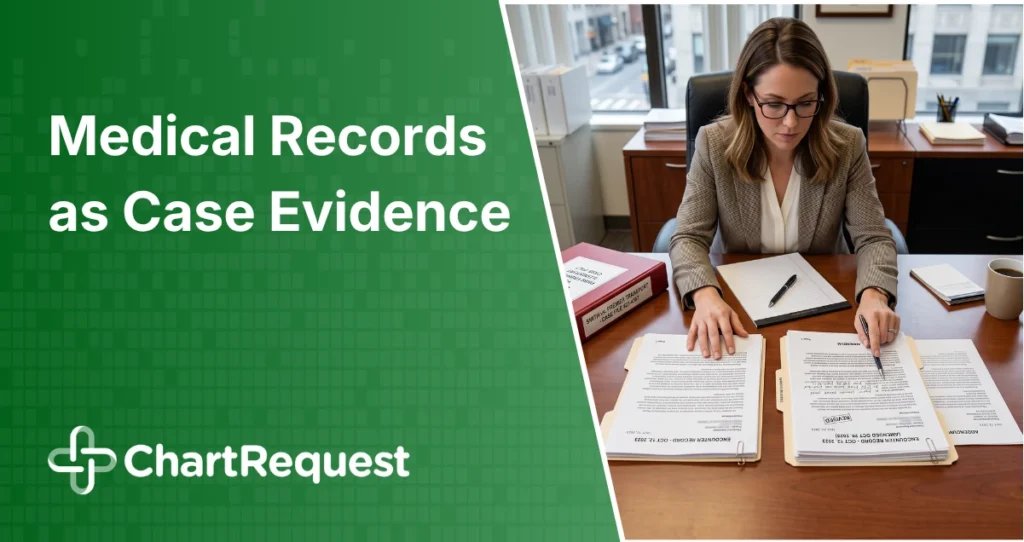



A medical record can look final long before its documentation history is finished.
When legal teams use medical records as evidence, that documentation can show symptoms, findings, testing, and treatment. But notes may also be completed later, corrected, supplemented, or amended after the original encounter.
That creates a version control problem for legal teams. A complete record set involves more than having every document the firm requested. The team also needs to know which version it is reviewing and whether later documentation changed the picture.
Table of contents
- How Are Medical Records Used as Evidence in a Legal Case?
- Why Does Medical Record Timing Matter as Evidence?
- A Correction Does Not Mean Improper Alteration
- Five Record Changes Worth a Closer Look
- What Should a Case Manager Do When Records Differ?
- When Can an EHR Audit Trail Matter?
- When Does Record Review Become a Retrieval Question Again?
- Get the Updated Records Faster With CaseBinder
- Frequently Asked Questions

How Are Medical Records Used as Evidence in a Legal Case?
Medical records can document symptoms, diagnoses, clinical findings, testing, treatment, restrictions, and chronology. They do not automatically establish causation, damages, or another legal element. Those questions may require attorney judgment, testimony, expert analysis, and other evidence.
For a personal injury firm, the first operational question is whether the file contains the medical, billing, imaging, and other documentation the case team needs. Understanding the full set of records a legal team may need helps establish that baseline.
The next question is whether timing or later changes affect the records the team is relying on.
Why Does Medical Record Timing Matter as Evidence?
When reviewing medical records as evidence, the date of service and the documentation date may tell different parts of the story.
Under Federal Rule of Evidence 803(6), one requirement of the federal hearsay exception for records of a regularly conducted activity is that the record was made at or near the relevant time by, or from information transmitted by, someone with knowledge.
A note may show a date of service, an entry or signature date, and a later addendum date. The production date serves another purpose because it shows when the provider produced the records.
If a patient is seen on March 3 and the provider adds information on March 18, the later entry may concern the March 3 encounter while still being later documentation. The case manager’s job is to preserve that distinction for the case team.
Documentation timing is separate from medical record authentication and certificates of authenticity, which address the record’s source rather than when an entry was created or changed.
A Correction Does Not Mean Improper Alteration
Medical records can legitimately change after the original documentation is created. A correction may fix inaccurate information, an addendum may supplement a note, and a delayed entry may document information after the underlying service occurred.
A change by itself does not establish improper alteration.
The CMS Medicare Program Integrity Manual recognizes amendments, corrections, and delayed entries. CMS says the date and author should be identifiable and the change or addendum should be clearly and permanently denoted.
That guidance applies to Medicare medical review, not civil court admissibility. For legal teams, the practical questions are: What changed? When? Who made the change? Is that history visible?
A spelling correction usually deserves different attention than a later-added symptom, diagnosis, restriction, treatment detail, body part, or date.
Five Record Changes Worth a Closer Look
Pay closer attention when a change affects information or chronology the case team may rely on.
- A note is completed or signed well after the visit. Keep the service date and documentation date distinct.
- An addendum adds material clinical information. New symptoms, restrictions, history, or treatment details may change how the team understands the encounter.
- A correction changes a substantive detail. Changes to a diagnosis, treatment date, body part, finding, or treatment plan may matter more than clerical corrections.
- Two productions covering the same encounter appear different. Confirm that both requests covered the same provider, location, dates, and record types before assuming the chart changed.
- The chronology does not make sense from the face of the record. An entry may describe an earlier encounter but have been completed or supplemented later.
The useful dividing line is whether the difference affects the medical information or chronology the case team is using.

What Should a Case Manager Do When Records Differ?
First, confirm that the files are comparable. Check the provider, facility, encounter, date range, and requested record types. Different productions do not necessarily mean the underlying chart changed.
If the files cover the same material, preserve both versions and document visible differences in dates, signatures, addenda, authorship information, or substantive clinical details.
Also check for broader completeness problems. Our guide to catching incomplete medical records covers gaps caused by request scope, separate systems, and record compilation.
Case managers can organize the discrepancy and flag anything that could affect the case. Legal or clinical interpretation belongs with the appropriate attorney, expert, or clinician.
If the visible records still cannot explain a material difference, information outside the clinical note may become relevant.
When Can an EHR Audit Trail Matter?
A difference between two productions does not automatically mean the firm needs an EHR audit trail. Audit information becomes more relevant when a material discrepancy remains unexplained.
For Health IT Modules certified to ONC’s § 170.315(d)(10) auditing criterion, the technology must be set by default to record specified activity involving electronic health information. The criterion also requires date and time information and protections against changing, overwriting, or deleting recorded audit actions.
The certification criterion governs certified health IT functionality. It does not determine what a provider must produce in a lawsuit or records request.
The April 2026 New York decision Harms v. Lewis shows why audit information can matter in a discovery dispute. Deposition testimony contradicted earlier representations about audit trail availability and suggested that responsive information might still exist or had not been disclosed. The Appellate Division affirmed further discovery concerning the audit trails.
Harms is a New York medical malpractice discovery decision. It does not make audit trails automatically required or discoverable whenever medical records differ.
For case managers, the takeaway is operational: preserve the records, document the unresolved discrepancy, and flag it for appropriate review.
When Does Record Review Become a Retrieval Question Again?
An earlier production establishes what the firm received at that point in the case. It does not guarantee that the provider’s chart will remain unchanged.
If relevant documentation is later corrected or supplemented, the legal team may decide it needs a current or supplemental production. That can create another retrieval cycle involving provider outreach, status checks, follow-up, and escalation.
The firm decides what additional evidence the case requires. The retrieval workflow should make the next production easier to obtain without turning it into another manual project.
When a firm relies on medical records as evidence, completeness can involve more than missing pages or providers. The firm may also need the version of the record it intends to use.

Get the Updated Records Faster With CaseBinder
When the records already in the case file are no longer enough, the next production should not send the case manager through another round of provider calls, emails, and manual status checks.
With CaseBinder, law firms can submit and track medical record requests through one workflow while our retrieval experts handle provider follow-up and escalation. Real-time status visibility gives the case team a clear view of each request.
Your legal team decides what additional records or evidence the matter requires. We handle the retrieval work that follows so your staff can stay focused on moving the case forward.
Review your medical record retrieval workflow with ChartRequest to see how CaseBinder can support current, supplemental, and repeat requests.
Frequently Asked Questions
Are Medical Records Admissible as Evidence?
Courts may admit medical records when applicable evidentiary requirements are met. The answer depends on the jurisdiction, the record, its foundation, its contents, and how it is offered. In federal court, Rule 803(6) provides an exception to the rule against hearsay for qualifying records of regularly conducted activity.
What Makes Medical Records Useful as Evidence?
Medical records can document symptoms, diagnoses, testing, treatment, restrictions, clinical findings, and chronology. Their usefulness can also depend on timing, completeness, prior history, consistency, and how they fit with other evidence.
Can a Medical Record Be Corrected After It Is Signed?
Yes. Medical documentation can be corrected, amended, or supplemented after the original entry. The CMS Medicare Program Integrity Manual recognizes amendments, corrections, and delayed entries in the Medicare review context.
Does a Late Entry Make a Medical Record Unreliable?
Not by itself. Timing can be relevant, but the content, when the entry was added, who entered it, surrounding documentation, and applicable evidentiary rules may all matter.
Can an EHR Audit Trail Show When a Medical Record Changed?
It can provide information about record activity depending on the system and available audit data. For Health IT Modules certified to ONC’s § 170.315(d)(10) criterion, audit functionality includes specified activity and date and time information. The criterion governs certified health IT functionality, not what a provider must produce in a particular lawsuit or records request.