


When a case depends on medical records with a certificate of authenticity, the clock starts the moment you submit the request. Depositions, settlement conferences, and discovery deadlines are all waiting on what comes back. You need records that will hold up under scrutiny.
If you manage records requests, you know the frustration: requests that sit for weeks, incomplete packets that demand follow-up, and missing certificates of authenticity that force a second request to the provider.
When records run late, you are the one fielding the attorney asking where they are and giving clients dates you are not sure you can hold. The cost is wasted staff hours, stalled cases, and the stress of not knowing whether the documentation will land in time.
CaseBinder by ChartRequest removes those bottlenecks. You submit the request, and our retrieval experts handle all follow-up with providers. Here is how that works and what it means for teams managing tight deadlines.
Table of contents
- What Is a Medical Records Certificate of Authenticity?
- Why Do Law Firms Need Authenticated Medical Records?
- How Does CaseBinder Speed Up Authenticated Record Retrieval?
- How Can Legal Teams Track Outstanding Record Requests?
- How Does Centralized Request Submission Reduce Follow-Up?
- How Do Law Firms Get Certified Medical Records Fast?
- Frequently Asked Questions

What Is a Medical Records Certificate of Authenticity?
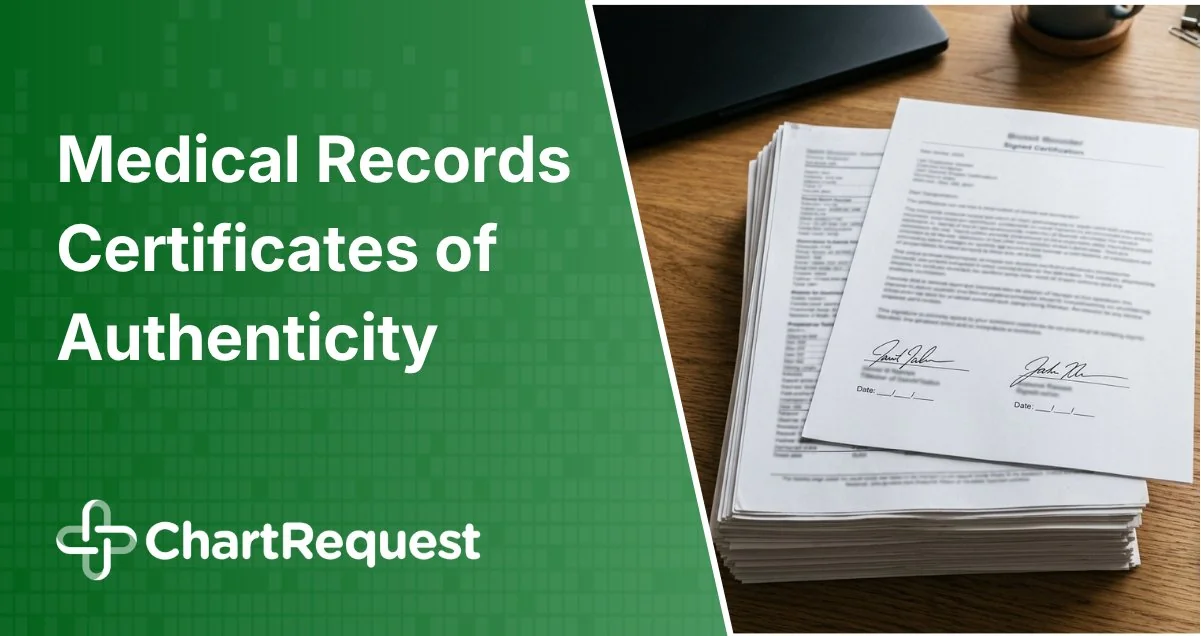
A certificate of authenticity is a signed statement from the custodian of records confirming that the attached documents are true and accurate copies of what exists in the provider’s system. In litigation, it lets you authenticate those records without calling the provider to testify in person.
This is sometimes called a medical records affidavit. Under Federal Rule of Evidence 902(11), a written certification can self-authenticate domestic business records, which removes the need for live testimony to establish authenticity.
Paired with the business-records hearsay exception in Rule 803(6), that certification clears the authentication and business-records hurdles for using medical records at trial. Rule 902(11) also requires you to give the opposing party reasonable written notice before trial and to make the records available for inspection.
Miss that step, and self-authentication can fail, putting the records at risk of exclusion.
Why Do Law Firms Need Authenticated Medical Records?
Law firms need authenticated records because unauthenticated records may not be trial-ready. To admit them as evidence, you would first have to prove they are genuine, often by calling the custodian to testify or chasing down a separate certification weeks into the case.
With CaseBinder, you can request a certificate of authenticity as part of the records order itself, in the same workflow and at the same time. You do not have to wait for the records, then go back to the provider for certification as a separate step.
For legal case managers, this removes a recurring source of rework. Instead of contacting the provider for certification after the records arrive, you add authentication to the request up front, so the records and the certificate come back together.
Certification also adds accountability.
A custodian’s attestation confirms the copy matches what is in the provider’s system and names a responsible signatory. This helps you catch records swapped or altered after they left the provider.
How Does CaseBinder Speed Up Authenticated Record Retrieval?
CaseBinder speeds up retrieval by taking provider follow-up off your team entirely. You submit the request, and our retrieval experts chase the providers, verify what comes back, and release the records for you.
The work moves through four steps:
- You submit the request through a guided, fully digital workflow. It takes a few minutes and includes an eAuthorization form your client can sign electronically. During this process, you can add a request for a certificate of authenticity.
- Our retrieval experts handle all follow-up with the provider, check on progress, and escalate when a request stalls.
- We verify the production matches the request, including the right patient, date ranges, and record types, follow up with the provider when records come back incomplete, and remove anything that falls outside the authorization.
- We release the completed records to your dashboard, with the certificate of authenticity included if requested.
Under HIPAA, providers generally have up to 30 days to respond to a records request, with one possible extension (45 CFR 164.524). Our internal data shows an average turnaround of 14 days for medical records retrieval with CaseBinder. Actual times may vary based on the details of the request and the practice receiving it.
Because our team owns the follow-up, your staff are not making status calls, sending faxes, or tracking requests in spreadsheets. A dedicated retrieval coordinator manages the process, which frees your team to focus on case work. That relief matters most for firms running high volumes of personal injury, medical malpractice, or workers’ compensation cases.

How Can Legal Teams Track Outstanding Record Requests?
Legal teams track outstanding requests through the CaseBinder dashboard, which shows the status of every request in one place. It updates in real time and is available online around the clock. You can see what is pending, in progress, or completed, message providers through built-in chat, pull reports, and download finished records directly.
The hardest part of traditional retrieval is the silence. A request goes out, and you wait, with no signal that the provider received it, started it, or is close to delivery. A live dashboard replaces those status calls and emails with a view your team can check at any time.
The dashboard also surfaces when a provider needs more information or a signature. If a provider raises an authorization issue, your retrieval coordinator flags it and works with you to resolve it right away, instead of the request stalling silently for weeks. For firms juggling many matters, a single view of every outstanding request across all active cases makes it easy to prioritize by deadline and give clients accurate timelines.
How Does Centralized Request Submission Reduce Follow-Up?
Centralized request submission reduces follow-up by consolidating all provider requests in one place, which reduces administrative drag and makes complex cases easier to coordinate. Automated reminders and status updates do the manual checking for you.
It also improves consistency.
Instead of navigating different provider portals, fax lines, and email threads, your team works from a single interface. This reduces errors and helps authorization forms meet each provider’s requirements on the first attempt. For legal operations leaders, that consistency means standardized intake across every matter and retrieval costs you can forecast.
The efficiency gains scale with case complexity. A personal injury matter spanning years and dozens of providers can generate hundreds of individual requests. Handled through traditional methods, that volume eats staff time and creates openings for requests to slip.
Our retrieval experts also handle the provider-specific nuances of medical records retrieval, including the heightened authorization requirements for sensitive records such as substance use disorder or mental health files. This means requests go out correctly the first time.
How Do Law Firms Get Certified Medical Records Fast?
Faster authenticated retrieval gives your firm predictable case timelines and reclaimed staff capacity. When records are in hand early, legal teams working the case can plan around real dates.
It also gives time back. Hours once spent calling providers and chasing certifications shift to case analysis and client work, which lets firms handle higher caseloads without adding headcount.
CaseBinder clears the bottlenecks that slow traditional retrieval. If record retrieval is creating drag on your caseload, schedule a CaseBinder demo and we will walk through how a dedicated retrieval management solution closes the gap.
Frequently Asked Questions
What Is a Certificate of Authenticity for Medical Records?
It is a signed statement from the records custodian confirming the attached documents are true and accurate copies of what is in the provider’s system. It lets you authenticate the records for trial without live custodian testimony.
Does a Certificate of Authenticity Make Records Automatically Admissible?
No. It establishes authenticity. An opponent can still challenge them on other grounds, such as hearsay or relevance, so the certificate clears one hurdle rather than all of them.
Does ChartRequest Handle Follow-Up With Providers?
Yes. With CaseBinder, our retrieval experts handle all follow-up with providers, check on progress, and escalate stalled requests, so your staff is not making status calls or sending faxes.
How Do You Get a Certificate of Authenticity With Medical Records Through CaseBinder?
You add authentication to the records order when you submit it, so the records and the certificate come back together. There is no separate request to the provider after the fact.
How Long Does Authenticated Medical Record Retrieval Take Through CaseBinder?
Our internal data shows an average turnaround of 14 days, and you can request a certificate of authenticity as part of the same order. Actual times may vary based on the details of the request and the practice receiving it.