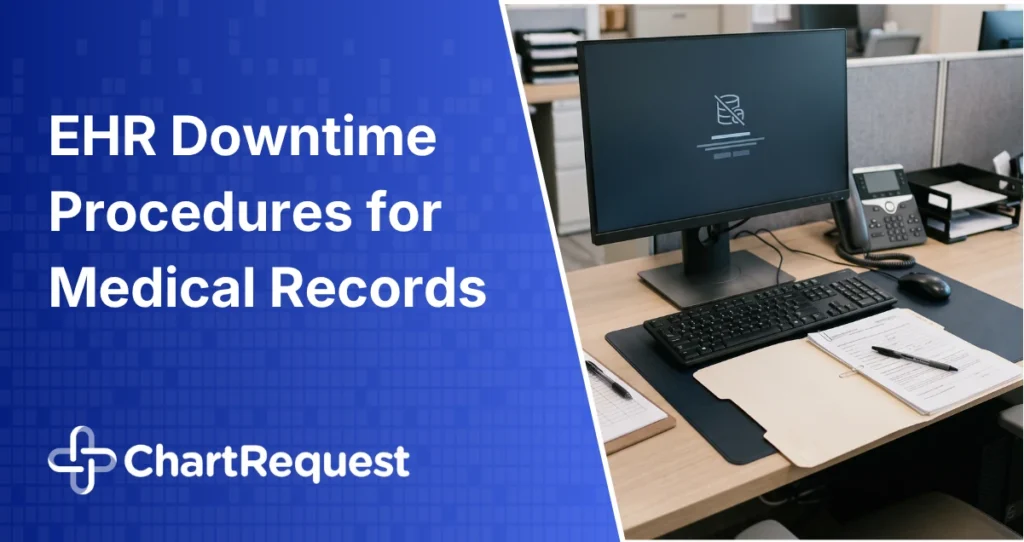



EHR downtime is any period when users cannot access all or part of an electronic health record. A full outage is usually easier to recognize. Partial downtime can be harder to control because staff may keep working while one dependency stops updating.
For release of information (ROI), a request may depend on the EHR, billing, imaging, document repositories, verification records, delivery tools, and outside vendors. If one part fails, the request may keep moving while part of its history is recorded elsewhere. ONC’s SAFER Contingency Planning Guide covers planned and unplanned EHR unavailability and ways organizations can reduce its impact.
Table of contents
- What Is EHR Downtime?
- For Medical Record Release, Plan for Three Downtime Phases
- Before Downtime: Map the Release Process and Its Dependencies
- During Downtime: Keep the Request Lifecycle Intact
- After Systems Return: Reconcile Before You Close the Incident
- HIPAA Requirements Continue During Downtime
- Test the Failure You Expect the Plan to Survive
- Your Release of Information Vendor Is Part of the Downtime Plan
- Keep Medical Record Release Traceable With ChartRequest
- Frequently Asked Questions

What Is EHR Downtime?
EHR downtime can affect an entire EHR or one connected function. The core EHR may remain available while an interface, picture archiving and communication system (PACS), document repository, patient portal, or authentication service is unavailable. Planned downtime gives teams time to prepare. Unplanned downtime creates more uncertainty around the cause, duration, and affected systems.
For Medical Record Release, Plan for Three Downtime Phases
For ROI, a practical downtime process follows three phases: prepare before the disruption, operate through it, and reconcile after systems return.
| Phase | IT Priority | Medical Record Release Priority |
| Prepare | Map dependencies, responsibilities, communication, and alternate systems | Decide how requests, verification records, and available records will stay controlled |
| Operate | Activate approved downtime procedures and manage system access | Track requests, verification decisions, disclosures, and exceptions |
| Reconcile | Validate recovery and return workflows to production | Account for requests and disclosures handled during downtime |
Downtime can temporarily create a second operational record outside the normal system. A request may move through verification, assignment, fulfillment, and delivery while the primary workflow is unavailable. Those actions still need to become part of the permanent request history.
Before the plan is ready, the team should know which systems ROI depends on and where downtime activity will be recorded. It should also identify who can approve exceptions, which record sources remain available, and how open requests will be reconciled.
Before Downtime: Map the Release Process and Its Dependencies
An ROI workflow may depend on the EHR, identity services, billing and imaging systems, document repositories, delivery tools, network connectivity, and outside vendors.
HHS administrative safeguards guidance includes sample questions about whether contingency planning covers electronic protected health information (ePHI) across systems beyond the primary electronic medical record. Examples include patient accounting, diagnostic images, test results, and electronic documents.
Map dependencies, not just applications. Two systems may rely on the same identity provider, network connection, interface, hosting environment, or third party. IT, HIM, privacy, and ROI teams should also know who activates procedures, communicates changes, owns release operations, and approves exceptions.

During Downtime: Keep the Request Lifecycle Intact
First identify which part of the information chain failed and which systems remain approved for use.
Follow each request through its full operational lifecycle:
Received → Verified → Assigned → Fulfilled → Delivered → Reconciled
For each request, preserve enough information to identify the patient, requestor, requested records, time received, assigned owner, verification status, and fulfillment stage.
Staff should continue to verify requestor identity and authority when required. HHS verification guidance does not prescribe one universal method. Covered entities may use reasonable steps that fit the circumstances. System unavailability does not replace requestor verification.
Check record availability by source. A request may need clinical records from the EHR, billing from another platform, imaging from PACS, and scanned documents from a repository. Restoring one system does not necessarily make the full request ready to fulfill.
When staff complete a disclosure during downtime, the approved log should record what was released, to whom, by whom, when, and how.
If ransomware, unauthorized access, or another security incident may be involved, follow the organization’s incident response process first. HHS guidance on HIPAA security incident procedures requires regulated entities to identify and respond to suspected or known security incidents and document their outcomes.
After Systems Return: Reconcile Before You Close the Incident
Recovery does not end when employees can log back into the EHR.
A request may enter the queue before downtime, get verified before the outage, and then be released through an approved downtime process. When systems return, the original electronic request may still show as pending.
Without reconciliation, staff can duplicate fulfillment, leave an incorrect status, create an incomplete disclosure history, or struggle to prove what happened later. Peer-reviewed research on EHR downtime and uptime procedures treats recovery as a distinct phase that includes reconciliation and documentation.
Account for every request received, completed, delivered, or left pending during the outage. Bring related authorizations, disclosures, exceptions, and status changes back into the permanent workflow.
Recovery is complete when the organization can reconstruct what happened to the work, not simply when system access returns.
HIPAA Requirements Continue During Downtime
HIPAA does not prescribe one universal downtime workflow. The Security Rule requires covered entities and business associates to maintain contingency procedures for emergencies that damage systems containing ePHI.
Under 45 CFR § 164.308, required components include data backup, disaster recovery, and emergency mode operation plans. Testing and revision procedures and applications and data criticality analysis are addressable implementation specifications.
The Security Rule applies to ePHI, while the HIPAA Privacy Rule protects PHI more broadly. An approved paper process still must protect PHI.
Existing patient access requests remain subject to the applicable response timeline. HHS guidance on access-request timing says a covered entity generally must act within 30 calendar days of receiving an individual’s request. The rule permits one additional 30-day extension when the covered entity provides the required written notice.
For a broader look at HIPAA ROI compliance controls, the same verification, disclosure, and documentation disciplines matter during normal operations and downtime. Other federal or state laws may impose different or shorter requirements.
Test the Failure You Expect the Plan to Survive
A downtime exercise conducted while every supporting system still works does not fully test the plan.
If the procedure covers loss of EHR access, test it without normal EHR access. If it should survive a network, interface, identity, or vendor disruption, recreate that failure during the exercise.
For an ROI tabletop exercise, start with an open request already in progress. Remove access to one required system and complete the steps that remain permitted. Then restore the dependency and determine whether staff can reconcile the request without duplicate work, missing history, or an incorrect status.
AHRQ research reviewed 80,381 patient safety incident reports and identified 76 related to downtime. Among those 76 reports, 46% indicated that procedures were not followed or were not in place. This is not a national failure rate. It does show the difference between having a procedure and being able to execute it.
For ROI, the test is simple: can the team account for every open request after restoration?

Your Release of Information Vendor Is Part of the Downtime Plan
The dependency review should extend beyond systems the organization owns.
Before relying on an ROI partner for continuity, IT should understand which functions depend on customer-controlled systems. Ask how requests are tracked, what request-level history remains available, and how open work can be reconciled.
The same discipline matters when switching release of information vendors. Open requests can span outgoing and incoming workflows, so ownership and reconciliation need to be explicit.
Security assurance also deserves scrutiny. When evaluating SOC 2 for a medical record vendor, look beyond the existence of a report. Understand which controls were included in the examination. The AICPA Trust Services Criteria cover security, availability, processing integrity, confidentiality, and privacy.
A vendor can have strong internal controls while still depending on systems inside the healthcare organization’s environment. Define those boundaries before an outage.
Keep Medical Record Release Traceable With ChartRequest
A downtime event is the wrong time to discover that request history is difficult to reconstruct.
We give healthcare organizations a structured release of information workflow from intake through fulfillment. Request-level audit history and activity visibility help teams distinguish what is pending, what is complete, and where follow-up remains.
For IT and HIM leaders, the evaluation should go beyond a feature demo. We can map our workflow against your existing ROI environment, identify remaining dependencies, and show how request activity stays visible from intake through fulfillment.
Schedule a ChartRequest demo to review your ROI workflow and see how request tracking, audit history, and reconciliation could support your downtime process.
Frequently Asked Questions
What Is EHR Downtime?
EHR downtime is a period when users cannot access all or part of an electronic health record. It may be planned or unplanned and can affect the full EHR or one connected system, interface, or service.
What Should Be Included in an EHR Downtime Checklist?
An EHR downtime checklist should cover activation criteria, ownership, staff communication, approved workflows, documentation requirements, return to service procedures, and reconciliation.
Does HIPAA Require an EHR Downtime Plan?
HIPAA does not specifically require a document called an “EHR downtime plan.” The Security Rule requires contingency procedures for emergencies that damage systems containing ePHI. Required components include data backup, disaster recovery, and emergency mode operation plans.
Do Medical Record Requests Stop During EHR Downtime?
Not automatically. Some activity may need to pause depending on the unavailable systems or whether a security incident is involved. HIPAA individual access requests remain subject to the applicable response timeline and permitted extension process.
What Should Be Documented During a Medical Record Release?
Document enough information to reconstruct the request and disclosure. That includes requestor identity and authority, verification or authorization status when applicable, records released, recipient, staff member, timing, delivery method, exceptions, and reconciliation status.