


An MRI report can arrive in a medical records packet while the underlying images remain outstanding. A case manager may discover the difference only when an expert asks to open the scan or compare it with earlier imaging.
In an MRI personal injury claim, the report and the images serve different purposes. Knowing which one the next reviewer needs can prevent another retrieval cycle just as the case moves toward expert review or demand preparation.
Table of contents
- MRI Images vs. the Radiology Report: What Does the File Contain?
- What Can an MRI Show in a Personal Injury Claim?
- When Do Personal Injury Firms Need the Actual MRI Images?
- Why Do MRI Images Get Missed During Record Retrieval?
- What Should Case Managers Request for an MRI Personal Injury Claim?
- Keep Imaging Retrieval Moving With CaseBinder by ChartRequest
- Frequently Asked Questions
MRI Images vs. the Radiology Report: What Does the File Contain?
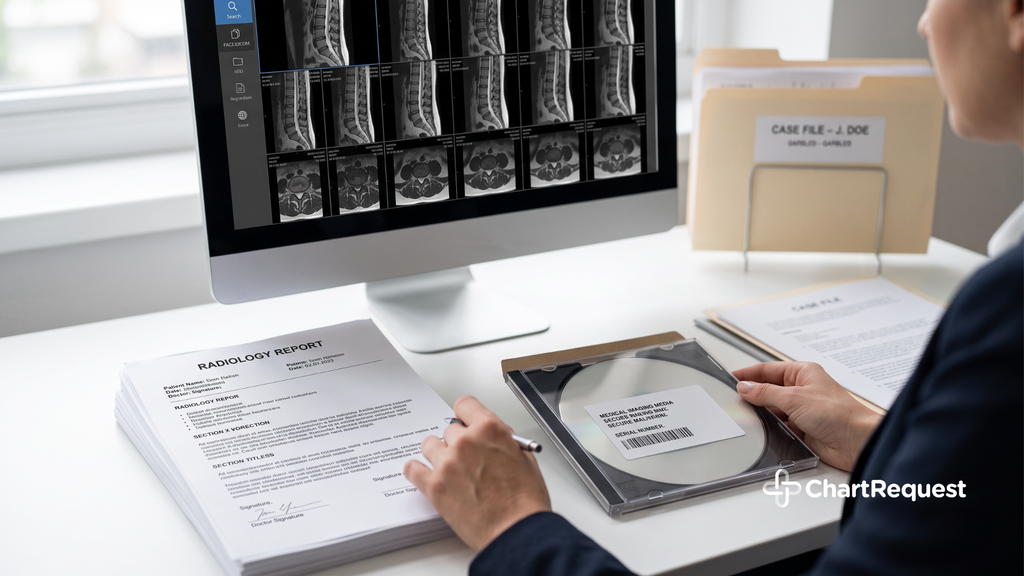
The radiology report contains the interpreting radiologist’s written findings and impression. The MRI images are the diagnostic study behind that interpretation. Receiving one does not confirm that the other arrived.
| Radiology Report | Actual MRI Images |
| Written interpretation of the examination | Underlying diagnostic image files |
| Summarizes findings and an impression | Allows a qualified reviewer to examine the study directly |
| May reference earlier imaging | Can support direct comparison with earlier or later studies |
| Often arrives as a PDF with treatment records | May require a separate imaging transfer or delivery method |
HHS confirms that diagnostic images can be part of a patient’s designated record set under the HIPAA right of access. That guidance describes an individual’s access right. A law firm must still use the appropriate authorization or other legal authority for its request.
If your tracking system has only one status labeled “MRI received,” it may hide a missing deliverable. Confirm separately whether the report and the source images are present when the case requires both.
What Can an MRI Show in a Personal Injury Claim?
MRI provides detailed views of soft tissue and structures such as joints, ligaments, tendons, and spinal disks. RadiologyInfo’s explanation of musculoskeletal MRI describes how clinicians use it to evaluate injuries and other conditions.
An MRI finding does not establish when an injury occurred or what caused it. In a systematic review of spinal degeneration, researchers examined 33 studies involving 3,110 people without symptoms. The estimated prevalence of disk degeneration rose from 37% among 20-year-olds to 96% among 80-year-olds.
Those figures concern spinal imaging findings in people without symptoms. They cannot determine the cause of an individual client’s condition. For a legal case manager, the useful task is to collect the imaging alongside relevant treatment notes, prior studies, and medical history for qualified review.
When Do Personal Injury Firms Need the Actual MRI Images?
The report may be sufficient for an early case review. Whether the attorney also needs the images depends on the next use of the medical evidence.
When an Expert Needs to Review the Study
An attorney may ask a radiologist, orthopedist, neurologist, or another qualified medical professional to examine the MRI. If the reviewer needs to assess the study firsthand, the original radiology report cannot replace the images.
Before the handoff, confirm which study the expert needs and whether the delivered files open in the reviewer’s system.
When the Report References Earlier Imaging
A current lumbar MRI might refer to an earlier study from another date or facility. Read the report’s comparison section and ask whether the reviewer needs that older study.
For an MRI personal injury claim involving prior studies, track four separate imaging deliverables:
- Current MRI report: received
- Current MRI images: outstanding
- Prior MRI report: outstanding
- Prior MRI images: outstanding
Keeping those items separate helps the team identify what still requires a request or follow-up.
When Prior Findings or Causation Are Under Review
A medical reviewer may need earlier imaging, specialist notes, or treatment records involving the same body part. Those materials help establish the clinical history the reviewer will evaluate.
The case manager’s role is to locate the relevant records and organize the dates. Attorneys and qualified medical professionals determine their significance for the case.

Why Do MRI Images Get Missed During Record Retrieval?
A treating physician may mention an MRI performed at an outside imaging center. The treating office can send its clinical notes and a copy of the radiology report without supplying the original image files.
Before sending the request, identify the facility that performed the study and confirm who fulfills image requests. Be specific if the attorney needs the diagnostic images; a broad request for “all records” may result in the report alone.
This problem also appears when assembling medical records for personal injury cases. Treatment, imaging, and billing may come from different custodians, even when they relate to the same visit.
What If the MRI Report Arrives Without the Images?
An MRI report without the images is a partial delivery when the legal team needs both. Mark the report received and keep the images outstanding. Use the study date, body part, and performing facility to identify the correct custodian. The treating practice may have only the report; the radiology department or outside imaging center may fulfill the images.
Check the original request. Did it specify the diagnostic image files? If so, ask what prevented fulfillment and whether the custodian needs a different delivery method. If not, submit a request for the exact study under the appropriate authorization or legal process. Record the next follow-up date and verify that the files open for the intended reviewer.
What Should Case Managers Request for an MRI Personal Injury Claim?
Treat the radiology report and diagnostic images as separate deliverables whenever the legal team needs both. Before closing the request, check the following:
- Identify the study. Record the exam date, body part, imaging facility, and study type.
- Confirm the intended use. Ask whether the attorney or expert needs the report, the images, or both.
- Find the image custodian. Verify who can provide the underlying study, especially when the treating office has only the report.
- Specify the deliverables. Name the study and expressly request the image files when needed.
- Verify what arrived. Match the report and files against the request, including any earlier comparison studies.
- Test expert access. Confirm that the intended reviewer can open the images before the handoff.
Medical image files may arrive in formats intended for imaging systems rather than ordinary PDF readers. The DICOM standard governs how medical imaging information is exchanged. A case manager need not interpret the files, but should confirm that the expert can use what arrived.
Before demand preparation, review the complete medical record packet for references to missing imaging or earlier treatment. In an MRI personal injury claim, the next step depends on having the material the attorney or reviewer actually needs.

Keep Imaging Retrieval Moving With CaseBinder by ChartRequest
An imaging request can stall when a facility needs clarification, a record component is missing, or follow-up moves between departments. Those calls and status checks take time away from case preparation.
With CaseBinder by ChartRequest, your team can submit and track medical, imaging, and billing requests through a centralized retrieval workflow. Our retrieval experts handle provider follow-up and escalation for the records you request. Your case managers can focus on preparing the file and coordinating the next review rather than chasing the provider.
Schedule a CaseBinder retrieval workflow review to see how our team can take provider follow-up off your staff’s desk.
Frequently Asked Questions
Is an MRI Report the Same as the Actual MRI Images?
No. The radiology report documents the interpreting radiologist’s findings, while the images are the underlying diagnostic study. A legal team may need one or both, depending on the purpose of the review.
Do You Need MRI Images or Just the Report for a Personal Injury Claim?
It depends on how the attorney or expert plans to use the imaging. A report can support an initial file review. Direct expert examination or comparison with earlier studies may also require the diagnostic images.
Can an MRI Prove That an Accident Caused an Injury?
Not by itself. MRI findings contribute to the medical evidence, but causation requires consideration of symptoms, examination findings, treatment history, prior records, and qualified medical opinion.
What If the MRI Is Normal but the Client Still Reports Symptoms?
Preserve the report and relevant clinical records. A case manager should not infer that the reported symptoms are invalid because an MRI lacks a particular finding. The attorney and qualified medical professionals can assess the evidence in context.
How Should a Legal Case Manager Request MRI Images?
Identify the study date, body part, and imaging facility. Confirm which custodian fulfills image requests, specify whether the report and actual MRI image files are needed, and verify that the intended reviewer can access the delivered study.