
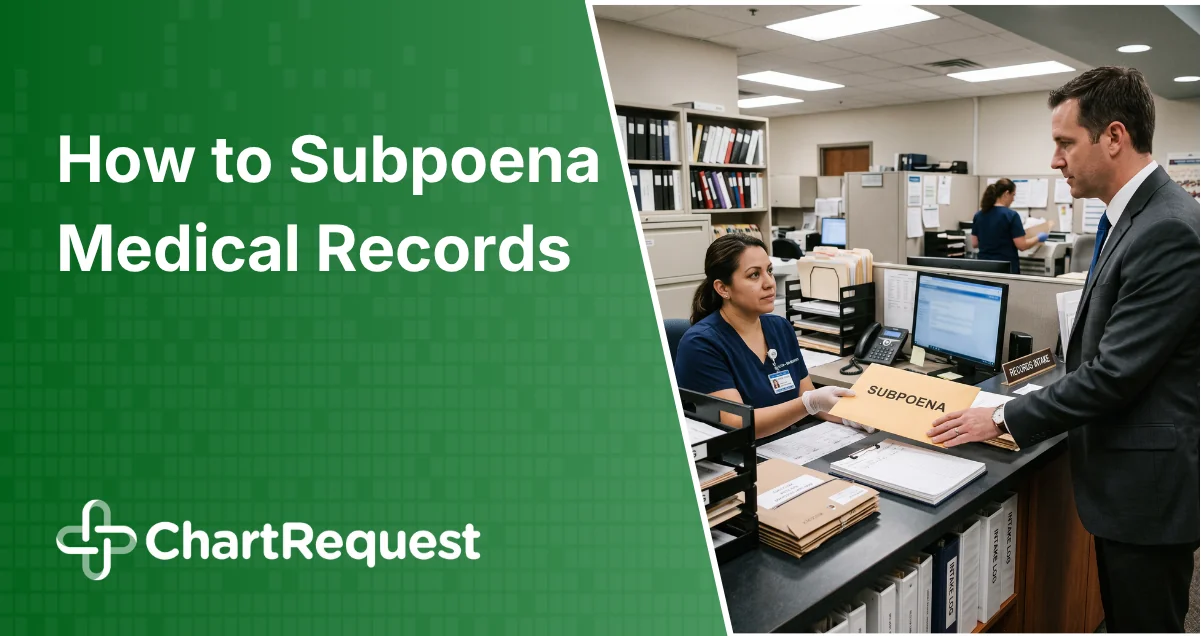


To subpoena medical records, a law firm needs to follow the relevant court procedure, identify the proper records holder, satisfy the requirements governing disclosure, and complete service. From there, the case team still has to track the request through production and make sure the records that arrive match what was requested.

Table of contents
- Can Medical Records Be Subpoenaed?
- How Do Law Firms Subpoena Medical Records?
- 1. Confirm Which Subpoena Rules Apply
- 2. Identify the Records Holder and Subpoena Recipient
- 3. Specify What the Medical Records Subpoena Should Include
- 4. Prepare the Subpoena and Supporting Documents
- 5. Complete Service Under the Relevant Rules
- 6. Calendar the Response and Objection Deadlines
- 7. Track the Subpoena Through Production
- Does “All Medical Records” Include Everything a Firm Needs?
- How Does HIPAA Affect a Medical Records Subpoena?
- What Happens After You Serve a Medical Records Subpoena?
- How Can Law Firms Check a Medical Records Production for Gaps?
- How Can Law Firms Reduce the Follow-Up Behind Medical Records Subpoenas?
- Frequently Asked Questions
Can Medical Records Be Subpoenaed?
Yes. Law firms can subpoena medical records when they satisfy the procedural rules for the matter and the requirements governing disclosure.
A properly issued subpoena does not by itself determine whether a provider may disclose the requested records. HIPAA, state law, privilege, and other confidentiality protections can also apply.
How Do Law Firms Subpoena Medical Records?
There is no single procedure for every medical records subpoena. Federal and state rules differ, and the records involved can add other requirements.
Before using a subpoena, determine whether formal legal process is appropriate for the records sought. A valid HIPAA authorization can permit a covered entity to disclose protected health information consistent with that authorization. Subpoenas and court orders operate through different legal mechanisms.
A subpoena duces tecum generally directs a person or organization to produce specified documents or records.
For most firms, the workflow comes down to seven steps:
- Confirm which subpoena rules apply.
- Identify the records holder and subpoena recipient.
- Specify what the medical records subpoena should include.
- Prepare the subpoena and supporting documents.
- Complete service under the relevant rules.
- Calendar the response and objection deadlines.
- Track the subpoena through production.
1. Confirm Which Subpoena Rules Apply
Start with the court rules and statutes for the matter. Determine the following:
- Whether federal or state procedure controls
- Where the matter is pending
- Where the records holder is located
- Whether interstate discovery procedures apply
- Who may issue the subpoena
In federal civil litigation, a court clerk may issue a signed but otherwise blank subpoena to a requesting party. An attorney authorized to practice in the issuing court may also issue and sign a subpoena as an officer of that court.
The current Federal Rules of Civil Procedure provide the federal framework for issuance, service, objections, compliance, and motions to quash or modify.
2. Identify the Records Holder and Subpoena Recipient
Verify which organization holds the records and which legal entity the subpoena should name.
A patient may have received care through a hospital system, physician practice, imaging center, therapy provider, or separate billing entity. Different portions of the requested record set may sit with different organizations.
The records holder, legal entity named in the subpoena, service recipient, and department processing the request may also differ.
A request sent to the wrong organization can sit in the case tracker without moving toward production. Once the mistake surfaces, the team may have to correct the paperwork, redirect the request, and complete service again.
3. Specify What the Medical Records Subpoena Should Include
Define what the case requires and what the required subpoena form or court rules call for.
Depending on the jurisdiction and proceeding, the subpoena may need to identify:
- The court and case information
- The patient whose records are sought
- The provider, facility, or records holder
- The requested date range
- The specific record categories
- The production or compliance date
- The place or permitted method of production
- Any required certification or custodian documentation
Specify the record categories the case requires rather than relying on broad language alone. An unnecessarily broad request can create objections or production problems, while a vague request makes it harder to determine whether the provider fulfilled the subpoena.
4. Prepare the Subpoena and Supporting Documents
Prepare the subpoena under the rules for the proceeding and identify any additional documentation or privacy process the provider needs before production.
The legal process and the disclosure requirements both have to be right. Fixing one does not fix the other.
5. Complete Service Under the Relevant Rules
Service requirements depend on the jurisdiction.
Before service, verify:
- Who may serve the subpoena
- Who must receive it
- Which service methods are permitted
- Whether advance notice to other parties is required
- Whether proof of service must be filed or retained
- Whether the records holder’s location changes the required process
Document service clearly so the case team can track the deadlines that follow.
6. Calendar the Response and Objection Deadlines
There is no single nationwide response deadline for medical records subpoenas. Production and objection dates depend on the rules for the matter and the terms of the subpoena.
Calendar those dates rather than applying the HIPAA Right of Access timeline to a litigation subpoena.
Federal Rule 45 provides one example. A person commanded to produce documents generally may serve a written objection before the earlier of the compliance date or 14 days after service. That is an objection rule for federal subpoenas, not a universal medical records production deadline.
7. Track the Subpoena Through Production
Use a status sequence that shows where the request actually stands:
Served → processing → issue identified → issue resolved → production received → production reviewed
That is more useful than an open-or-closed status because it shows whether someone needs to act.

Does “All Medical Records” Include Everything a Firm Needs?
Not always. A request for “all medical records” can sound comprehensive even though litigation records may sit across different departments, systems, or organizations.
A clinical chart may arrive without billing records. The production may also include an imaging report without the underlying diagnostic images. Records maintained by an affiliated physician group may not appear in the hospital’s production.
Depending on the case, firms may need to identify:
- Clinical and operative records
- Billing records and itemized statements
- Therapy and specialist records
- Diagnostic imaging reports and actual image files
A complete clinical chart can still leave the legal team without part of the record set it needs.
See the medical records legal teams may need for a personal injury case for a deeper breakdown.
How Does HIPAA Affect a Medical Records Subpoena?
A procedurally valid subpoena and a HIPAA-permitted disclosure are related but separate questions.
Under 45 CFR 164.512(e), a covered entity may disclose protected health information expressly authorized by a court or administrative tribunal order. HIPAA applies different conditions to certain subpoenas, discovery requests, and other lawful processes without such an order.
More stringent state privacy laws and separate record-specific confidentiality rules may also apply.
For the notice, qualified protective order, and other federal privacy mechanics, see HIPAA subpoena requirements for law firms.
What Happens After You Serve a Medical Records Subpoena?
After service, someone still needs to manage the request through production.
Confirm the Request Is Moving
Determine whether the request reached the organization that handles medical records subpoenas and entered its processing workflow.
When progress stalls, identify the reason. The firm may have targeted the wrong entity, missed documentation, encountered a service issue, or reached another barrier.
Resolve Issues That Stop Production
When a provider identifies a problem, distinguish between an administrative issue the retrieval team can resolve and a legal issue that requires attorney attention.
A generic “pending” status does not tell the case team whether the request is processing normally, waiting on documentation, facing an objection, or simply stalled.
Track the Request Through Production
Compare incoming records with the subpoena before closing the request. Account for each requested category and date range, and review provider correspondence for signs that another department or organization is handling part of the production.
A no-records response is also an outcome that needs review before the request is closed. If a provider reports that no responsive records exist, check what a no records found certificate means and whether the response resolves the request.
How Can Law Firms Check a Medical Records Production for Gaps?
Receiving a packet does not automatically mean the provider fully satisfied the medical records subpoena.
Compare the production against the subpoena and known case information. Check whether:
- The correct provider or organization responded
- The requested date range is represented
- Expected clinical and treatment records are present
- Requested billing records and itemized statements arrived
- Requested imaging reports and image files are accounted for
- Certifications or other required supporting documents are present
- Partial or no-records responses have been investigated
This review cannot prove from the packet alone that every responsive record has arrived. It can identify gaps before attorneys, experts, or case staff rely on the file.
Finding those gaps during demand preparation, expert review, or another deadline-driven stage forces the case team back into retrieval when it expected to be working from a complete file.
For a deeper completeness review, see how to identify incomplete medical records.

How Can Law Firms Reduce the Follow-Up Behind Medical Records Subpoenas?
A single case may involve several providers, each with its own status, deficiency, production date, and follow-up path. Across an active caseload, staff end up managing a retrieval queue alongside the legal work itself.
With CaseBinder, our retrieval experts handle provider follow-up and escalation while your firm retains control of subpoena strategy and case decisions.
See where CaseBinder could reduce provider follow-up in your current retrieval workflow. Schedule a retrieval workflow review.
Frequently Asked Questions
Can Medical Records Be Subpoenaed Without Patient Authorization?
Yes, in some circumstances. Patient authorization is not the only potential basis for a covered entity to disclose medical records. A subpoena-based request still has to satisfy the procedural requirements and any HIPAA, state law, privilege, or record-specific requirements that apply. Under HIPAA, the analysis depends in part on the type of legal process involved.
Is a Medical Records Subpoena the Same as a Court Order?
No. A subpoena and a court order are different forms of legal process. HIPAA treats them differently as well. A covered entity may disclose protected health information expressly authorized by a court or administrative tribunal order. Certain subpoenas and discovery requests without such an order must meet other requirements under 45 CFR 164.512(e).
How Far Back Can Medical Records Be Subpoenaed?
There is no single nationwide number of years for every medical records subpoena. The relevant date range depends on the case, discovery rules, subpoena scope, available records, and any objections or limitations. Firms should define the needed period rather than assume every historical record is available or discoverable.
What Happens if a Provider Does Not Respond to a Medical Records Subpoena?
First determine what stopped the request. Check the subpoena recipient, service, production date, any deficiency notice, and whether an objection or other barrier exists. The appropriate legal response depends on the rules and circumstances, so there is no universal enforcement step for every unanswered subpoena.
Can a Medical Records Subpoena Be Challenged?
Yes. Depending on the jurisdiction and circumstances, a party or subpoena recipient may object or seek protection based on scope, privilege, confidentiality, burden, or procedural defects. Federal Rule 45 provides specific objection and quash-or-modify procedures for federal subpoenas, while state procedures can differ.