




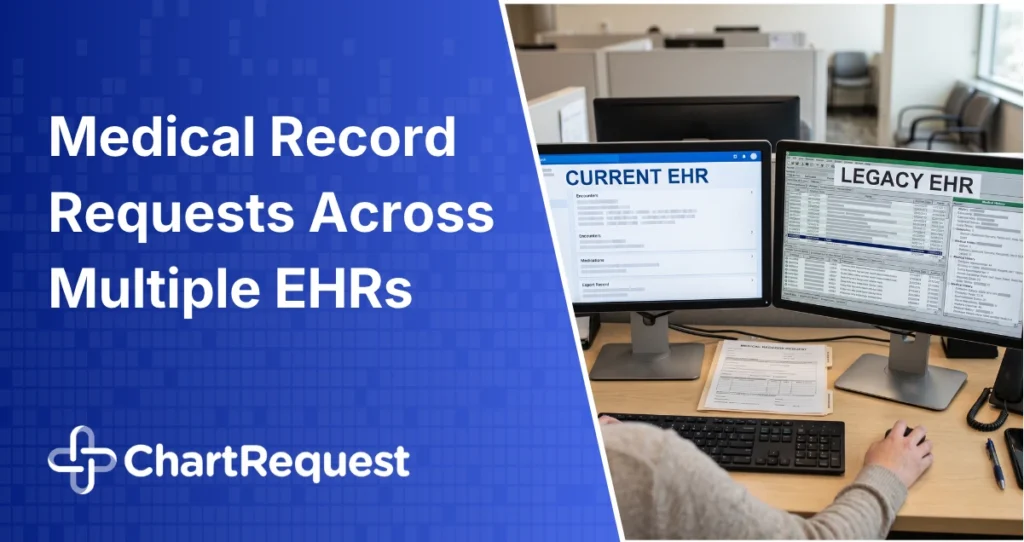
A practice can switch EHRs and still need the old system to complete a patient’s records request. Even when the current EHR shows a completed export, HIPAA’s 30-day patient access clock keeps running while staff retrieve qualifying archived records. Medical record requests across multiple EHRs require someone to track what is still missing from the full response.
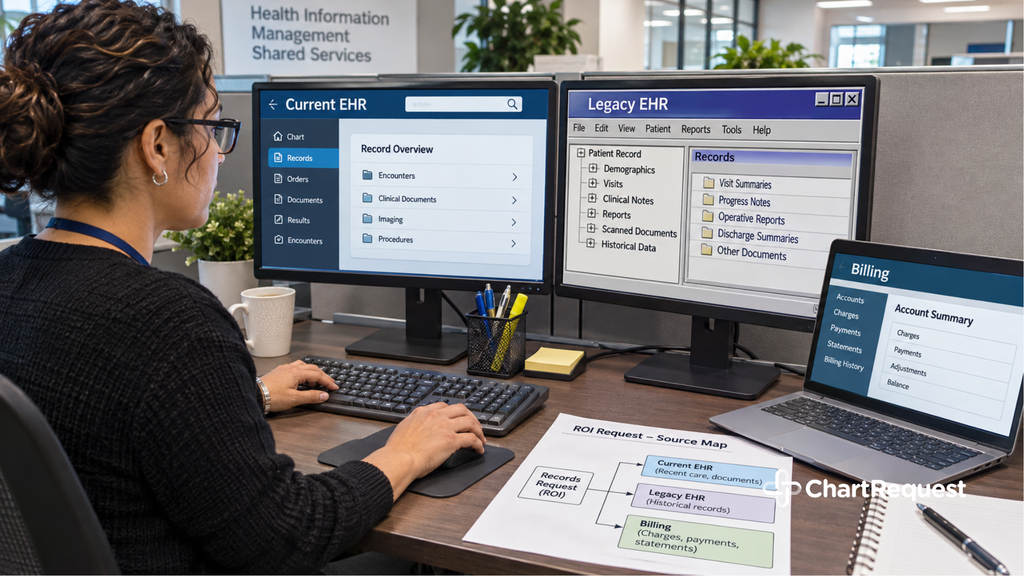
Consider a hypothetical four-location medical group operating as one HIPAA covered entity. After switching EHRs in 2024, it left older encounters in a legacy system and billing in another application. A patient requests clinical and billing records from January 2021 through September 2026. One employee coordinates the response across three sources.
Moving to one EHR can simplify future retrieval, but older charts and separate billing files still need a coordinated response. Our multi-site medical records release guide covers organization-wide standards; this article focuses on assembling records across EHRs.
Table of Contents
Why Do Medical Record Requests Span Multiple EHRs?
Medical record requests across multiple EHRs can result from routine technology changes, not just acquisitions:
- EHR replacements. Older encounters may stay in a legacy application or archive rather than move into the new system.
- Phased rollouts. Locations can move onto a new platform at different times, leaving staff with different access and export procedures.
- Specialty workflows. Imaging, rehabilitation, and other service lines may maintain documentation in separate clinical applications.
- Location-specific configurations. Even practices using one EHR vendor may have different permissions, modules, and retrieval procedures.
- Separate billing systems. A practice management application is not another EHR, but its records may still be needed to fulfill a request.
System changes involve more than installing new software. The federal Health IT Playbook addresses access to historical information, and the Association of Cancer Care Centers describes workflow differences between sites using the same vendor.
The consequences appear when staff need to retrieve records. A 2018 GAO report on patient access documented the effort of gathering information from digital and paper sources. A 2022 AHIMA case study of CommonSpirit Health described information blocking compliance work involving at least 12 EHR and legacy systems and more than 30 customized worksheets. The CommonSpirit project was not a release turnaround study.
For medical record requests across multiple EHRs, inventory where each location keeps current encounters, older charts, specialty documentation, and billing. Identify the handoffs before changing the workflow.
Which Record Sources Belong in a Medical Records Request?
Start by identifying the request type, the records and dates requested, and the entity responsible for responding. An individual’s HIPAA right of access is governed by 45 CFR section 164.524. Certain disclosures that require an authorization follow 45 CFR section 164.508. The distinction determines which disclosure and response rules apply.
For patient access, designated record sets can include qualifying medical, billing, and payment records maintained by or for the covered entity. Exporting the current clinical chart may therefore leave part of the request unanswered.
How Do You Map Record Sources Across EHRs?
For medical record requests across multiple EHRs, a shared source map shows who owns each component and what remains open. In the hypothetical group:
| Record Source | Responsible Team | Status | Next Action |
|---|---|---|---|
| Current EHR, 2024 to 2026 | Records release team | Retrieved | Confirm patient, dates, and scope |
| Legacy EHR, 2021 to 2023 | Authorized archive contact | Access blocked | Work with IT to restore approved access |
| Billing platform, 2021 to 2026 | Billing records team | Retrieved | Verify requested billing information |
The current EHR and billing records are retrieved, but the legacy archive is still blocked. The coordinator keeps the overall request open.
An escalation record helps resolve the problem; it does not fulfill the records request.
The responding entity matters as much as the location of the files. Common ownership alone does not make separate practices one covered entity. Eligible organizations may make a documented affiliated covered entity designation. Likewise, accessing another organization’s information through an exchange network does not automatically make those records part of the responding entity’s designated record set.
Who Owns Medical Record Requests Across Multiple EHRs?
For medical record requests across multiple EHRs, assign one coordinator who can see each source alongside the overall response. That person tracks whether retrieval, review, a disclosure decision, or delivery is still pending.
Use four steps to keep every source accounted for:
- Register the request. Record its receipt date, type, authority, scope, and deadline.
- Assign sources. Identify who can access each system and the approved retrieval method.
- Resolve exceptions. Keep the next action, owner, escalation, and requestor updates visible.
- Review and respond. Verify the assembled records, deliver what is authorized, and document the outcome.
AHIMA’s June 2026 workflow assessment guidance recommends examining the tasks, systems, handoffs, and outputs involved in day-to-day work. Employees can often identify the work that goes unseen: repeated logins, unanswered messages, and calls that interrupt other responsibilities.
At ChartRequest, we support centralized medical records release across locations through software and managed services. Practices can retain fulfillment internally or transfer agreed processing and requestor support to our team, depending on their systems and service arrangements.
What Happens When Legacy EHR Records Are Unavailable?
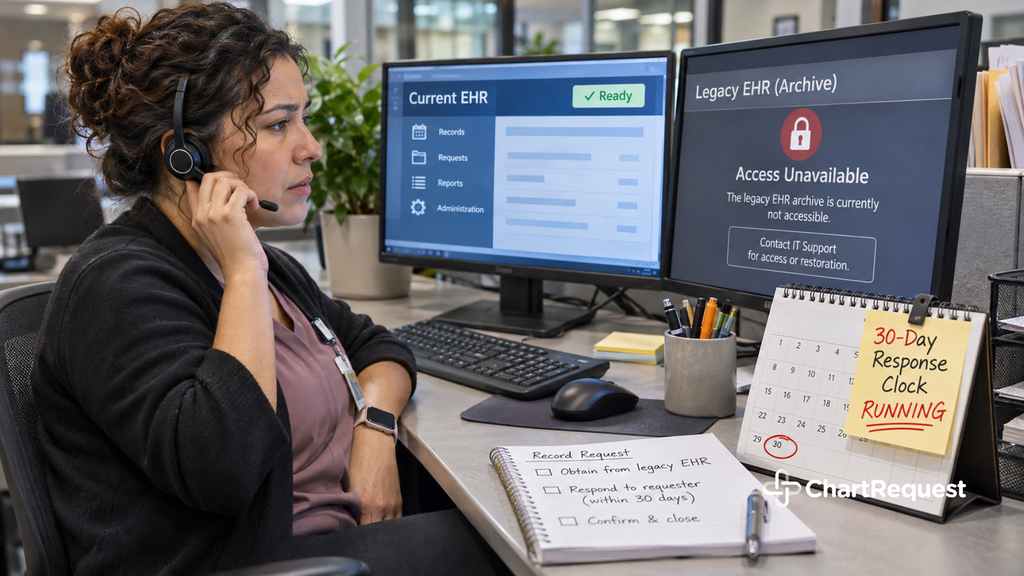
When medical record requests across multiple EHRs stall because an archive login fails, the coordinator assigns an authorized IT contact, tracks the deadline, and identifies who will update the requestor. The employee who received the request need not repeatedly chase IT.
When IT restores approved access, the archive contact retrieves older encounters for the release team to review with the other records.
If access remains blocked, the organization must pursue an appropriate alternative and involve compliance or legal staff when needed. A technical access problem alone does not justify denying a patient’s right of access.
For HIPAA patient access, a covered entity generally must act within 30 calendar days of receipt. One extension of up to 30 additional days is available if the regulatory conditions are met, including timely written notice. HHS explains that archived-record retrieval and business associate handoffs do not restart the clock. HHS also encourages staged delivery near the outer deadline when the individual wants available records that way. Other request types and state laws may have different requirements.
An HHS final rule published November 19, 2026 will shorten that federal patient-access response period to 15 calendar days. The rule takes effect January 18, 2027, with compliance required by July 17, 2027.
For managed release services, the provider and service team should agree in advance who handles status inquiries, system access, requestor communication, and disclosure decisions.
How Do You Know the Response Is Ready?
Before closing medical record requests across multiple EHRs, compare all retrieved materials against the original scope, patient, dates of service, billing items, and delivery instructions. Investigate missing encounters, incomplete exports, and records belonging to another patient.
Some sources will contain duplicates, no responsive records, or information outside the request’s scope. Staff should record the outcome and apply the relevant disclosure rules. HIPAA permits only limited grounds for denying patient access. When a valid ground applies to part of a request, the entity must provide other requested information to the extent possible.
Close the request only after source review, appropriate disclosure decisions, and authorized delivery.
How Much Work Still Falls on Practice Staff?
Medical record requests across multiple EHRs can consume staff time that turnaround reports never show. A receptionist may answer several status calls while a billing specialist steps away from claims work. Another office may spend time restoring access to the archive, even when the request ultimately meets its deadline.
Review a 30- to 60-day sample of medical record requests across multiple EHRs, including staff interviews. Track where cross-system coordination creates the most work:
| Measure | What It Shows |
|---|---|
| Multi-source requests | How often work crosses systems or locations |
| Internal staff touches per request | Time spent retrieving records, following up, and answering questions |
| Time awaiting source resolution | Delays tied to access problems or handoffs |
| Correction or reprocessing rate | Work repeated because records were missing or incorrect |
The comparison becomes useful when two locations handle similar requests in very different ways. One office may retrieve older charts directly, while another must contact an archive owner and follow up with IT. Both requests might close on time, but the second places more demands on staff. That difference makes medical records staff workload easier to assess and helps identify what could be simplified or handed off.
Which Release of Information Tasks Can Your Practice Hand Off?
Better tracking does not remove the work. For medical record requests across multiple EHRs, our managed release of information services can take on agreed retrieval, quality review, and requestor support so practice employees spend less time on these tasks.
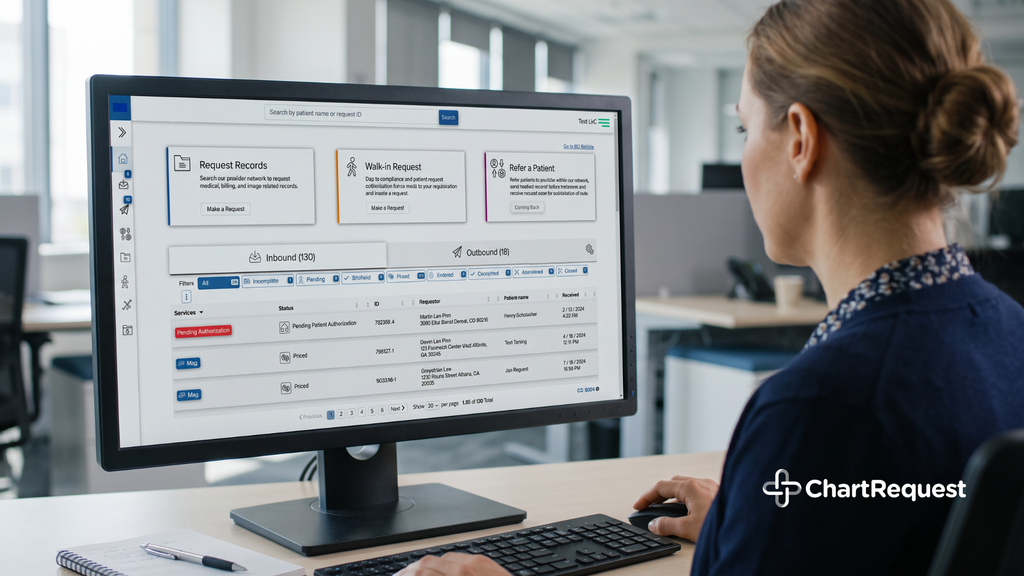
Requestors can check status online instead of calling the practice. When our experts handle requests for eligible provider partners, ChartRequest guarantees an average turnaround time of five business days. This is an average, not a deadline for every request; archive access problems and provider disclosure decisions may affect individual timelines.
During implementation, we agree on access and responsibilities. Practice staff may still authorize system access, identify the custodian, or make disclosure decisions. Each EHR may require a different approved retrieval method.
What Did HealthQuest Gain From Managed Release?
Our HealthQuest Physical Therapy case study describes a customer with 42 or more locations. Between July and December 2024, we processed more than 500 requests. The case study reports a 2.4-day average turnaround for that implementation and an average of 50 staff hours saved weekly on records-related work. HealthQuest said its employees could spend more time handling medical claims and other duties.
HealthQuest used a Raintree integration, so these historical results reflect that customer’s implementation. Those results do not establish automatic access to every EHR or predict outcomes for another practice. When comparing medical records release companies, ask specifically who will handle outstanding requests, follow-up, and exceptions.
Make Multi-EHR Records Requests Easier on Your Staff
An EHR export can be marked complete while a medical records request remains open. For practice administrators, the bigger problem is how often the missing piece sends employees back to an archive, a billing system, or another location.
Your 30- to 60-day workflow review should reveal which handoffs repeatedly stall, which tasks trigger more status calls, and which decisions only your staff can make. That distinction matters: a shared dashboard improves visibility, but it does not make retrieval and follow-up work disappear.
ChartRequest can help turn those findings into a practical division of responsibilities. In a personalized demonstration, we will review your systems and request mix, show which retrieval and requestor follow-up tasks our managed release of information team could handle, and clarify what stays with your practice. Find out what your staff could stop chasing and what your team would still control.
Schedule a Personalized Demonstration
Frequently Asked Questions
Who Is Responsible When Records Are Stored Across Different Practice Locations?
Start with the entity responsible for responding, not simply the location of the files. For one covered entity, a designated coordinator can track each system owner and confirm that the full response is complete. When locations are separate covered entities, common ownership or shared software does not automatically combine their HIPAA responsibilities.
What If a Legacy EHR Is Unavailable When a Records Request Is Due?
Assign the problem to an authorized archive or IT contact, investigate another approved source, and involve privacy or compliance staff if the response deadline is at risk. An inaccessible archive does not, by itself, pause the HIPAA patient-access clock. Apply any permitted extension, notice, or partial-response procedures under the rules that govern the specific request.
Does This Approach Apply to Attorney and Insurance Requests?
Yes. Source mapping and clear ownership can support attorney and insurance requests, but the disclosure authority, scope, fees, and deadlines may differ. Do not assume every request follows the HIPAA individual right-of-access rules.
Can a Managed Release of Information Service Work With Different EHR Vendors?
It may. Not every EHR supports a direct integration, so confirm supported systems, approved manual retrieval methods, and who resolves archive-access or cross-system exceptions before implementation.
What Should a Practice Check Before Retiring a Legacy EHR?
Confirm where historical clinical and billing records will be stored, who can retrieve them, and how open requests will be completed during the transition. Test approved archive access before shutdown. HIPAA does not establish a universal clinical record retention period; applicable state and other rules may govern retention.