


A medical record retention and destruction policy answers three questions: what records you keep, how long you keep them, and how you document destruction. A strong policy ties those answers to several sources. Those sources include HIPAA access and amendment rights, state retention laws, federal program requirements, and your own organizational policies. When the policy stops at general statements, staff cannot execute it the same way twice. That inconsistency creates audit exposure.
The designated record set determines which information falls under HIPAA access and amendment rights, so it also shapes your retention schedule. You need to separate three buckets. One holds protected health information inside the designated record set. Another holds the same information when it sits outside that set. The third covers material that is not protected health information at all.
Designated record set content has to survive long enough to support individual rights under 45 CFR 164.524. Other content can follow different rules. That line drives how you structure schedules and make destruction decisions.
Clean documentation of retention schedules, destruction procedures, and designated record set classifications supports compliance and lowers litigation risk. Review the policy on a regular cadence so it keeps pace with changes in law, technology, and organizational structure. When written policy no longer matches observable practice, the HHS Office for Civil Rights reads that gap as a warning sign. It signals that the organization wrote the program but never ran it. That gap drives some of the costliest HIPAA penalties on record.
Table of contents
- Why Retention and Destruction Policies Need Operational Detail
- How Do State Laws Impact Medical Record Retention and Destruction Timelines?
- How Litigation Holds Affect Destruction Decisions
- What to Document Before You Destroy Records
- How to Verify and Document the Destruction Method
- How to Assign Ownership for Retention and Destruction Workflows
- Pressure-Test Your Workflow Before an Auditor Does
- Frequently Asked Questions

Why Retention and Destruction Policies Need Operational Detail
Plenty of organizations run on a retention policy that someone wrote years ago, copied from a generic template, and rarely opened since. It may have been accurate the day someone signed it. Then workflows changed, systems moved, and responsibilities shifted. A line that says records last seven years tells no one how the work actually happens. It does not name who starts the clock, which systems hold the records, or how staff document destruction.
Operational detail turns a compliance document into a workflow your team can run. The policy should name the role that starts the retention clock and list the systems inside the retention inventory. Finally, it should specify what staff must complete before destroying any record. Skip that detail, and you get inconsistent interpretations and retention periods that drift by department.
Treat the policy as a living document. Do not wait for an audit or a breach to force a review. Work through one operational area at a time. Review one workflow each quarter, such as record destruction or litigation hold management, and the policy stays aligned with reality. That cadence also spares you the overwhelming job of rewriting everything at once.
Thin operational detail shows up fastest under audit. When an auditor asks how you set retention periods for imaging records, your answer should trace to a written procedure. Your team should apply it consistently. Asked how you prevent premature destruction, you should be able to point to a specific control. An auditor accepts documentation like this as proof the policy runs day to day. General awareness does not survive that conversation.
How Do State Laws Impact Medical Record Retention and Destruction Timelines?
HIPAA does not set a retention period for medical records. State medical record retention laws do, and they vary widely. Some states set a minimum number of years after the last patient encounter. Others tie pediatric retention to the age of majority. Several impose longer periods for specific record types, such as imaging studies or substance use disorder records.
One distinction trips teams up. HIPAA does require covered entities to keep certain compliance documentation, such as policies and procedures, for six years under 45 CFR 164.530(j). That obligation covers your HIPAA paperwork, not the clinical record itself. Do not let the six-year documentation rule stand in for an actual medical record retention schedule.
If you operate in more than one state, apply the most restrictive period that touches each record type. That takes a state-by-state read of the law and a documented rationale for the schedule you adopt. The policy should say which state’s law governs records created in each location, and how you will monitor changes to those requirements.
State law also drives destruction timing. If a state requires seven years after the last encounter, the clock starts only once you establish that encounter date. Ongoing care resets it with each new visit. For a patient not seen in years, the period may have already closed. The policy needs to say how you identify records eligible for destruction and confirm the retention period is complete.
Federal program requirements can add time on top. Medicare Conditions of Participation require hospitals to keep medical records for at least five years under 42 CFR 482.24. State Medicaid programs may go longer. Spell out how federal requirements interact with state law so staff always apply the longest applicable period.
How Litigation Holds Affect Destruction Decisions
A litigation hold suspends your normal destruction schedule. It applies when you reasonably anticipate that records will be relevant to current or future litigation, investigations, or audits. The hold stands even after the standard retention period expires. Destroying records under hold exposes the organization to spoliation claims, sanctions, and adverse inferences.
The policy must name who can issue a hold. It must also say how that hold reaches destruction staff and how you track the records it covers. Most holds fail at scoping, because no one has written down how to decide which records the hold covers. Say a hold covers everything tied to one patient. You then have to find every system that holds that patient’s records and freeze destruction across all of them at once.
Document holds with the same rigor you apply to destruction. Capture the issue date, the scope of records covered, the systems affected, the staff notified, and the date the hold lifts. Without that record, you cannot prove you took reasonable steps to preserve evidence. Missing proof is itself a source of risk.
The policy should also cover how you restart normal destruction once a hold lifts. Records eligible for destruction before the hold may still qualify once it ends. But you have to document that you re-evaluated the retention period and authorized destruction again. That paper trail shows an auditor you did not destroy anything early and that your decisions stayed consistent.

What to Document Before You Destroy Records
Destruction decisions need enough detail to show you applied the policy consistently and did not act early. At a minimum, capture:
- The date you authorized destruction
- The retention period you satisfied
- The systems you destroyed records from
- The destruction method you used
- The staff member who authorized destruction and the one who carried it out
- Whether the records sat under a litigation hold, and if so, the date that hold lifted
None of this works without a complete system inventory. You cannot account for every copy of a record if you do not know every place it lives. A useful inventory lists the systems plus their owners, data stewards, retention rules, and access pathways. A good one also flags any system-specific limits that affect how teams retrieve or amend records. That same inventory makes a clean release of information possible when a patient or attorney asks for the full file.
How to Verify and Document the Destruction Method
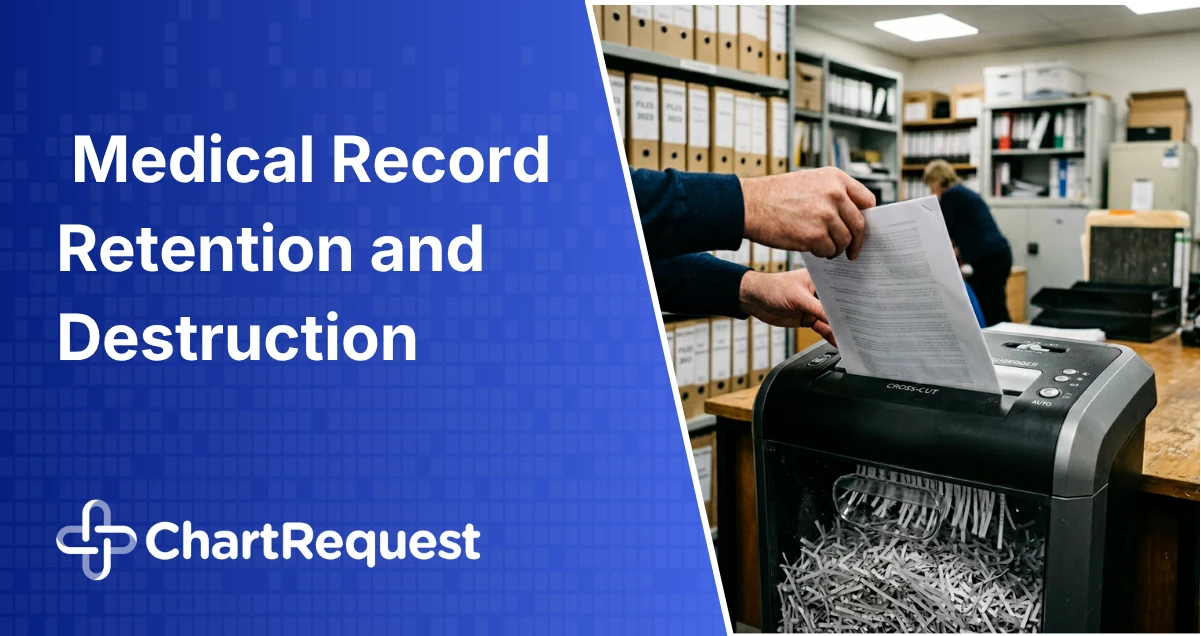
Your documentation must also show that the destruction rendered the records unreadable and unrecoverable. Paper records call for shredding, pulping, or incineration. Electronic media require overwriting, degaussing, or physical destruction, all methods HHS disposal guidance recognizes.
The policy should state which method you approve for each record type and how you confirm the team finished the work. Without that confirmation, you leave the exact gap auditors look for. When someone asks how you know the team destroyed records on schedule, point to logs, authorization records, and verification. A verbal assurance does not count.
How to Assign Ownership for Retention and Destruction Workflows
Retention and destruction need a clear owner at every step. The policy should name who starts the retention clock, who identifies records eligible for destruction, who authorizes it, and who executes and documents it. Leave ownership vague and workflows stall, decisions slip, and records pile up past their required period.
Teams often assume health information management will run the whole thing alone. In practice, these calls cross departments. Legal may need to screen records for litigation risk first. Compliance may need to confirm that no regulatory hold applies. Clinical leadership may need to verify that care no longer needs the records. Reinforce ownership through training. Make sure each owner can describe their role, the documentation they complete, and the control that prevents early destruction.
Keeping Access Intact During Mergers and EHR Transitions
Mergers, acquisitions, and electronic health record migrations are where retention programs quietly break. During these events you have to maintain continuity of access to the designated record set. That continuity spans legacy systems, archives, and the new platform. That means three things. Identify every system that holds designated record set content. Classify archived data. Confirm that individuals keep their access and amendment rights no matter what changes underneath.
When data does not fully import, and no one keeps the legacy system reachable, access requests come back incomplete. Those incomplete responses turn into compliance findings and litigation risk. Document your designated record set boundaries during any consolidation. Spell out which systems you keep, which you archive, and how staff reach archived data. This is the same continuity work we see organizations struggle with on the retrieval side. It keeps your retention and destruction workflows honest about where records actually live.

Pressure-Test Your Workflow Before an Auditor Does
A retention and destruction policy is only as good as your ability to produce records when someone asks for them. That ability depends on three things you have already mapped: a clear designated record set, a current system inventory, and a documented trail behind every decision.
Retention and destruction stay your responsibility. Release of information is the piece you can hand off. When an audit, a subpoena, or a litigation hold puts you on the clock, someone has to produce those records complete and documented. They sit across every system and provider that holds them.
We take that production work off your plate.
We pull records from wherever they live, across your systems and the providers in our network. We also chase the provider follow-up your team rarely has time to manage. You get back a complete file with the documentation an auditor expects. With release of information handled, your team has room to focus on the parts of compliance only you can run, retention and destruction among them.
To see how your access and retrieval workflow holds up when you actually have to produce records, schedule a demo or consultation, and we will walk through it with you.
Frequently Asked Questions
How Long Must You Retain Medical Records Under HIPAA?
HIPAA does not set a retention period for medical records. State law governs retention timelines, and you apply the most restrictive state requirement for each record type. Federal program requirements, such as Medicare Conditions of Participation, can add obligations on top. HIPAA separately requires six-year retention of compliance documentation under 45 CFR 164.530(j).
What Must You Document Before Destroying Records?
Capture the date you authorized destruction, the retention period you satisfied, the systems involved, the destruction method, and the staff who authorized and executed it. If the records sat under a litigation hold, document the date the hold lifted and the authorization to resume destruction.
Who Is Responsible for Managing Retention and Destruction Workflows?
The policy should assign an owner to each step: starting the retention clock, identifying eligible records, authorizing destruction, and executing and documenting it. Most programs require coordination across health information management, legal, compliance, and clinical leadership.
How Do Litigation Holds Affect Destruction Schedules?
A litigation hold suspends normal destruction when you reasonably anticipate that records will be relevant to current or future litigation, investigations, or audits. It applies even after the retention period expires. Destroying records under hold exposes the organization to spoliation claims and sanctions.
What Happens to Retention Schedules During an EHR Transition?
Retention schedules have to account for every record location, including legacy systems that never fully migrate. Keep those systems reachable, classify archived data, and document where each part of the designated record set lives. Access requests then stay complete after the switch.