ChartRequest is Proudly Partnered With


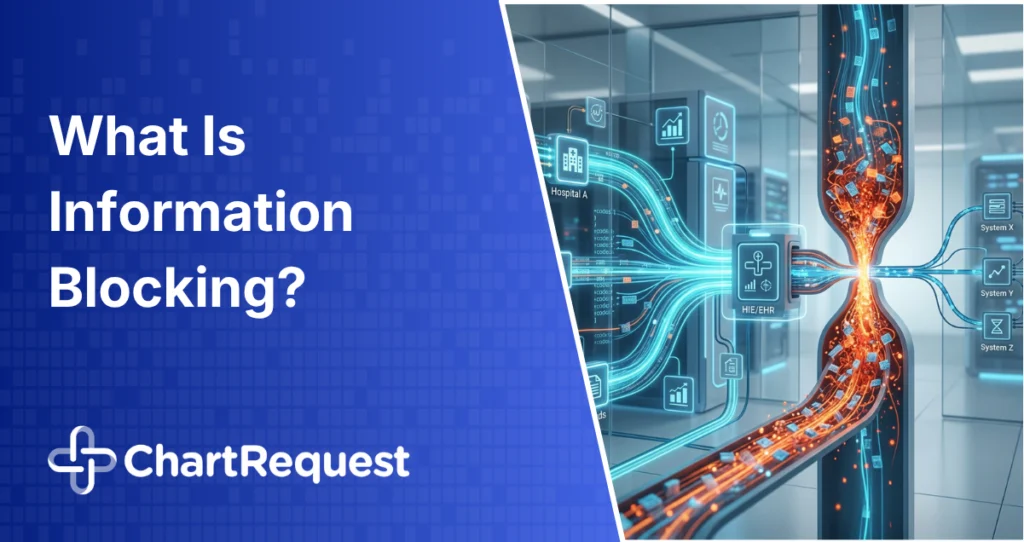
Medical data silos are a major problem in the healthcare industry. The added challenges of sharing medical records without violating HIPAA regulations can delay integral informed treatment. Fortunately, health information exchanges and HIE solutions can break down these silos and help speed up medical records turnaround.
What is Health Information Exchange?
Health information exchange (HIE) can refer to an organization that facilitates the exchange of protected health information or the act of exchange. Although the name is simple, the process is anything but simple. Failure to abide by the stringent yet flexible rules of HIPAA can cause massive financial penalties and rare prison sentences.
There are three types of Health Information Exchange: directed exchange, query-based exchange, and consumer-mediated exchange. Here’s a brief overview of each type, and we will go into more detail soon.
Directed Exchange: When healthcare providers exchange protected health information directly between each other in compliance with HIPAA regulations.
Query-based Exchange: When a healthcare provider retrieves protected health information themselves for unplanned and emergency services.
Consumer-mediated Exchange: When patients have access to their own medical records to share as they wish.
These three styles combine to facilitate the exchange of protected health information without involving unauthorized viewership. When an unauthorized individual does gain access to medical records, HHS considers it a breach.
The key goal of HIPAA is to find the ideal balance between medical record accessibility and security. Health information exchange is an inherently risky task due to the personal identifiable information (PII) condensed in each medical record. This is information that hackers love to get their hands on to either steal the patient’s identity or sell on the dark web.
When unauthorized individuals breach protected health information, the HIPAA Breach Notification Rule requires the organization or individual responsible for the breach to report it. The notification measures are based on the severity of the breach, and the financial penalties can reach colossal amounts.
Secure health information exchange is a legal requirement for medical organizations, but it’s a smart practice to perfect for the financial, administrative, and care benefits.
What are the benefits of HIE?
Risk mitigation is one of the main benefits of HIE. Medical error costs are difficult to truly measure, but the results can be catastrophic for those affected. Medical malpractice can cost medical facilities millions of dollars and cause patients lifelong disability or death.
Health information exchange is also an essential part of quality care coordination. Setting up an efficient care coordination process is an efficient way to improve patient care. The sooner physicians can access their patient’s medical history, the sooner they can begin working fully informed.
Patient care should be the main priority for any healthcare organization, but the benefits of quality health information exchange standards extend beyond the patient. The importance of HIPAA compliance cannot be understated, as violation penalties can be devastating.
A major determining factor in HIPAA violation is the method of medical records release an organization uses. Potentially unsafe methods like mail, email, text, and fax all come with greater inherent risk than dedicated exchange software can provide.
Efficient HIE can also motivate patients to play a more active role in their healthcare. For example, ChartRequest Subscribe & Share provides patients the option to develop personal health records for themselves and their families. This allows them to take control of their health information and share it when necessary.
Another major benefit is the centralization and organization of incoming requests. Without a dedicated software solution to manage medical records requests, they can oftentimes come in via multiple separate channels. Then, your team must collect, sort, and hopefully process them before the deadline.
Our HIE solution instead allows users to sort requests by the date received or their stage in the release process. This makes compliance a breeze and helps patients, legal professionals, and other physicians get records faster.
Directed Exchange
Directed exchange is a key aspect of care coordination. In this exchange method, healthcare providers share protected health information directly with each other. During directed exchange, healthcare providers must follow HIPAA release regulations.
Care coordination is one of the most cost-effective methods of improving patient care. The phrase “two heads are better than one” dates back to at least the 1500s for a reason. When two professionals can combine their medical expertise, the result is better patient care.
Ideally, this would be a simple process; we all want the best care possible. Unfortunately, the data silos created by incompatible electronic health record systems create barriers that block information sharing.
According to Healthcare IT News, the average hospital has affiliates who use 16 different EMR systems. For each of these affiliates, the healthcare provider must use alternative methods of release.
Every time your team releases protected health information, they’re risking HIPAA violations. It’s the responsibility of healthcare providers to choose the most secure method of releasing medical records possible.
No matter which method of HIE a healthcare organization uses, there are ways to release protected health information more safely. An easy way to significantly reduce the errors that can cause HIPAA violations is to simply double-check before releasing records.
ChartRequest utilizes a double quality assurance check on every medical records request. Double QA helps ensure the retrieved records are accurate in terms of the minimum necessary rule. This requires that healthcare providers release only the medical records specifically requested.
Query-based Exchange
Query-based exchange is different from both directed exchange and consumer-mediated exchange. While DE and CME require an individual to release medical records, a query-based exchange involves healthcare providers retrieving records themselves.
This method of exchange is used most often in emergency and unplanned situations where a patient cannot wait for a request to be processed.
For example, consider the Regional Health Information Organizations (RHIO). These health information exchange platforms accept medical records from healthcare providers within their region to create a patient record database.
Authorized healthcare providers can access these databases with a signed authorization form. Alternatively, in an emergency situation, the healthcare provider can “Break the Glass” to access these records without authorization.
While this method seems as though it could be less secure than the alternatives, the RHIO will investigate each use. If the individual who accessed the records did so without proper cause, they are penalized.
Because query-based exchange is reserved for unplanned and emergency situations, some healthcare organizations will never use this method. If your organization will utilize query-based exchange, make sure it’s done safely.
Double-check all the information before breaking the ice. Some names are common, and it would be unfortunate to need to break the glass twice. It would be even more unfortunate to use the wrong person’s medical information to treat a patient.
Don’t be dissuaded from using this type of exchange when relevant, but be certain that your team is doing so correctly.
Consumer Mediated Exchange
Consumer-mediated exchange depends on patients having their medical history on hand for distribution as necessary. This method of exchange is a win-win for patients and physicians, and a great option for your practice to promote.
Setting up efficient channels for healthcare providers to exchange protected health information is certainly important and beneficial, but patients bring a different element to the table when they’re in control of their medical records. These patients can usually list their medically-relevant allergies, provide a list of their medications, and follow their physician’s advice.
Benjamin Franklin said that an ounce of prevention is worth a pound of cure, and this often holds true in healthcare. Jogging, cutting down on fast food, and avoiding alcohol can help prevent or delay expensive emergency treatment.
Everybody is unique, and the preventative measures one should take to improve their health vary. Each patient should abide by the recommendations of their physicians. Without these notes on-hand, it can be difficult to remember the specifics of the doctor’s suggestions.
For these reasons, ChartRequest allows patients to upgrade to Subscribe & Share to help build their personal health records (PHR). Subscribe & Share allows patients to maintain their records on our secure platform indefinitely and empowers them to share these records as they see fit.
Alternatively, patients can store their records on their personal computers or a physical paper file. This can be done securely, but doing so digitally requires technical skills that aren’t universal. There’s a reason medical practices have such stringent cybersecurity measures.
Medical records contain a treasure trove of personal identifiable information (PII) that hackers can use to steal patients’ identities. We created Subscribe & Share to provide an option for patients who wish to keep their medical records – and their identities – secure.
Is HIE secure?
Health information exchange can be secure when performed correctly and with the proper security measures. Not all methods of medical records release are created equal, and some are likely to cause issues with the United States Department of Health and Human Services (HHS).
Due to the sheer scope of the medical industry in the United States, it can be difficult to find the true rates of issues like medical error, HIPAA violations, and the rate of unsuccessful health information exchange.
Most of the standard methods of medical records exchange are not universally secure. Humans make mistakes, and questionable methods of releasing medical records have more opportunities for error.
A fax number can be entered with just one number off. A physical copy can get lost in the mail or delivered to the wrong person. Regardless of how a breach happened, it cannot be taken back. Every breach of protected health information must be reported to HHS, and failure to report a breach makes penalties worse.
HIPAA penalties are determined on a case-by-case basis using four increasing penalty tiers. These tiers are based mainly on the severity of the breach, the duration of non-compliant release methods, and the culpability of the organization responsible.
For example, imagine a hospital that decided to start releasing medical records exclusively via text. This is an incredibly risky method of communication that will likely lead to a HIPAA violation before long. They are aware that this method isn’t right, but they make no effort to change it.
This hospital would likely face the highest penalty, which is up to $50,000 per violation, up to a maximum of $1.5 million per violation category per year. These costs can quickly add up and, in some cases, bankrupt the organization.
HIE Software can improve your HIPAA compliance
ChartRequest is a modern health information exchange platform that facilitates both directed exchange and consumer-mediated exchange. Our platform streamlines the entire process for both requestors and healthcare professionals.
While dedicated health information exchanges can be incredibly useful for healthcare providers within those systems, they are not as versatile as our release of information software. ChartRequest ensures all types of authorized requestors can access the medical records they need.
For requestors, signing up and submitting their first request takes just a few minutes. Once they have submitted their request, they can check for real-time status updates online. Additionally, our built-in provider chat function allows requestors to reach out with any questions without picking up a phone.
For your staff, this means up to two hours saved per request. For an estimate of the administrative savings.
To protect the sensitive information that passes through our platform every day, we utilize 128- to 256-bit end-to-end encryption. Additionally, we use the following additional measures to ensure hackers have no way to breach information:
- Redundant firewall protection,
- Redundant web application protection
- DoS and DDoS mitigation
- Monitored intrusion detection
- VPN/SSL and multi-factor authentication for server management
- Protection against MITM attacks, IP spoofing, Port Scanning, and Packet Sniffing
Additionally, ChartRequest helps protect your organization from HHS audits. Our automated audit log stores data for every single interaction with every single request. This makes it easy to prove that no unauthorized viewers accessed records or pinpoint the root cause of an error.
ChartRequest has two options for healthcare professionals: self-service and full-service. The main difference between these options is that self-service empowers your team to process requests more efficiently, while full-service utilizes our team of HIPAA experts to handle requests for you.
Facebook
Twitter
LinkedIn
Stay Updated
Find out the latest news and tips in our newsletter.
100% Privacy. No spam guaranteed.