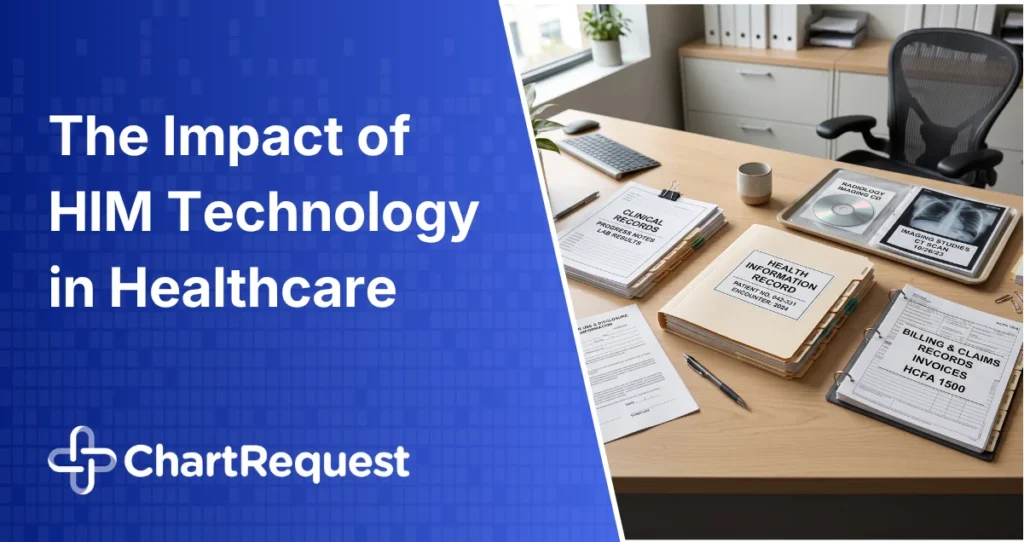



Health information management becomes more difficult as information moves across people, systems, departments, and organizations.
A record may be accurate in the EHR, but that does not guarantee the right person can find the information they need or determine what belongs in a response. They still have to access it appropriately and disclose it correctly when a request arrives.
Health information management (HIM) is the discipline that helps healthcare organizations manage health information across its lifecycle.
AHIMA defines HIM as the practice of acquiring, analyzing, and protecting digital and traditional medical information. In practice, HIM also connects the policies, people, processes, and technology used to maintain information, govern access, support appropriate use, and manage disclosure.
HIM extends beyond medical records administration because accuracy, access, privacy, and governance have to remain consistent across routine work, exceptions, staffing changes, and system boundaries.
Table of contents
- What Is Health Information Management?
- Why Is Health Information Management Important?
- What Does Health Information Management Do?
- Health Information Management vs. Health Information Technology vs. Health Informatics
- How Is Technology Changing Health Information Management?
- Where Does Release of Information Fit Into Health Information Management?
- How Does ChartRequest Help HIM Teams Improve the Release of Information?
- Frequently Asked Questions

What Is Health Information Management?
A medical record is one information asset within the broader HIM responsibility. HIM addresses the processes and controls that help keep health information accurate, protected, accessible, and usable over time.
That responsibility follows information from creation and maintenance through use, access, exchange, disclosure, and other downstream purposes.
AHIMA describes HIM professionals as a link among clinicians, administrators, technology designers, operations, and information technology professionals. Depending on the organization, the work may touch documentation quality, information governance, coding, privacy, patient access, and release of information. Data quality, analytics, and technology-supported processes may also fall within or intersect with HIM.
Why Is Health Information Management Important?
Healthcare organizations rely on the same information for many different purposes. Clinicians need it for care, while patients need access to it. Administrative teams use it for billing and reporting, and privacy teams help govern how it is accessed and disclosed.
The challenge is managing those requirements at the same time. Information needs to remain usable, appropriately controlled, accessible to the right people, and traceable across the organization.
HIM gives healthcare organizations a way to manage those requirements together.
Accurate Information Supports Patient Care
Healthcare professionals make decisions using information documented throughout a patient’s care. HIM supports the processes that help keep that information complete, accurate, and usable.
Records may span encounters, facilities, systems, and outside providers. Documentation practices can affect whether downstream users can find and understand the information available to them. AHIMA identifies completeness, accuracy, accessibility, and protection of patient information as central responsibilities within the profession.
Controlled Information Supports Privacy and Compliance
Healthcare organizations need consistent processes for managing access, use, and disclosure.
That can involve access controls, privacy policies, authorization review, disclosure rules, documentation, and staff responsibilities. HIM may own or intersect with these functions alongside privacy, compliance, security, clinical, and IT teams.
Applying those rules consistently becomes harder when access, use, or disclosure falls outside the routine path. Exceptions and multi-team handoffs test whether ownership is clear. They also show whether staff can determine what happened without reconstructing the process afterward.
Reliable Health Information Supports Revenue Cycle and Data Use
Coding, billing, reimbursement, audits, and related administrative processes rely on accurate, usable documentation.
The same information supports reporting, analytics, quality improvement, population health, and research. HIM helps maintain the quality and usability of the information those teams depend on while specialized teams remain responsible for how they apply it.
Accessible Information Supports Patients
Patients have rights to access much of the protected health information contained in a designated record set.
Under 45 CFR § 164.524, individuals generally have a right to inspect or obtain copies of protected health information about them in a designated record set. The rule includes specified exceptions.
HHS guidance on designated record sets, citing 45 CFR § 164.501, explains that these sets can include medical and billing records maintained by or for a covered healthcare provider.
For HIM teams, that access requirement has to become a functioning process. Staff need a reliable way to receive the request, understand its scope, and locate responsive information. They also need to determine the appropriate fulfillment path and document the outcome.
Usable Information Supports Healthcare Operations
Health information also needs to move among healthcare organizations and other requestors.
Providers exchange information to support treatment and care coordination. Patients request their records. Health plans and other requestors may need documentation for permitted or authorized purposes. ONC describes interoperability as supporting the access, exchange, and use of electronic health information across the healthcare system.
The organization still needs enough control to understand how information is being handled and where responsibility sits.

What Does Health Information Management Do?
HIM responsibilities differ across hospitals, health systems, practices, and other healthcare organizations. Most of the work supports a few core operating functions.
Maintain Complete and Accurate Health Records
HIM teams help establish processes that keep health information reliable over time.
Their work can involve documentation integrity, record completion, amendments and corrections, data quality, and consistency across systems. As information becomes more distributed, maintaining that integrity often requires coordination among several teams.
Protect Patient Privacy and Manage Appropriate Access
HIM helps translate privacy requirements into daily operations.
The work may include supporting access controls, managing disclosure processes, maintaining policies, coordinating with privacy and compliance teams, and documenting how information is handled.
A well-run process should make appropriate access possible while giving the organization enough visibility to understand how information was used or disclosed.
Support Coding, Billing, Analytics, and Other Downstream Uses
Health information supports coding, billing, audits, reporting, analytics, quality programs, population health, research, and other operational needs. HIM helps maintain the quality and usability of the information those teams depend on while specialized teams remain responsible for how they apply it.
Manage Access and Release of Information
Release of information (ROI) is one of the clearest places where HIM policy becomes day-to-day work.
A request can raise several questions. Who is asking, what information is in scope, and what authority permits the disclosure? Staff also need to know where the responsive records reside and how the information should be delivered.
Patient access adds specific requirements. When PHI in the designated record set is maintained electronically and the individual requests an electronic copy, §164.524 requires the covered entity to provide it in the requested electronic form and format if readily producible. If it is not readily producible, the covered entity and individual may agree on another readable electronic format.
ROI connects intake, review, record identification, fulfillment, delivery, and documentation. A delay or missed handoff at one stage can affect the rest of the request.
Govern Health Information Across the Organization
Information governance provides the policies, responsibilities, standards, and controls that guide how health information should be managed.
That work becomes more important when relevant information exists across clinical systems, imaging platforms, billing applications, document repositories, exchange networks, and other technology.
HIM turns those governance requirements into processes staff can apply consistently.
Health Information Management vs. Health Information Technology vs. Health Informatics
These disciplines overlap, but a practical distinction helps clarify their different roles.
| Discipline | Primary Focus |
| Health information management | Governance, quality, access, use, and management of health information |
| Health information technology | Systems and infrastructure used to store, secure, manage, and exchange health information |
| Health informatics | Applying health data and information systems to healthcare decisions and processes |
Health information technology supplies many of the systems used to store or exchange records. HIM focuses on how information is managed across those systems and the processes surrounding them. Health informatics focuses more closely on how data, technology, and information can support decisions and improve healthcare operations.
In practice, the functions work together. Technology supports HIM, while HIM provides governance and operational discipline around the information moving through that technology.
How Is Technology Changing Health Information Management?
Digitization has changed where HIM complexity appears.
Relevant information may reside across an EHR, imaging systems, billing platforms, patient portals, document repositories, outside organizations, and exchange networks. Federal policy and modern health IT also increasingly support electronic access and exchange.
ONC leads and coordinates nationwide interoperability activities.
TEFCA establishes a common governance, policy, and technical foundation for nationwide exchange. Those initiatives can make more information electronically available across organizations.
More electronic access does not automatically make coordination easier. One system may simplify a specific task while HIM still coordinates information across other systems, departments, and outside organizations. Faster exchange also makes it more important to know which pathway applies and who owns the next action.
Electronic ROI tools and automation can reduce manual steps in specific processes. Health information exchange networks can reduce some outside-provider retrieval work when the needed information is available through the network.
AI-assisted processes increase the importance of knowing which data a tool relies on, how information is surfaced, and where human review is required. Those questions belong within HIM governance because they affect how health information is interpreted and used.
Where Does Release of Information Fit Into Health Information Management?
Release of information brings several HIM responsibilities into one process: access, privacy, authorization, record identification, disclosure, delivery, request tracking, requestor communication, and documentation.
Some manual processes still rely on shared inboxes, fax queues, spreadsheets, and individual staff follow-up. As request types, locations, systems, and volumes expand, those handoffs become harder to see and manage.
The warning signs are usually practical. Staff field repeated status questions because the answer is not readily visible. A request stalls and ownership of the next step is unclear. Someone has to search emails or notes to understand what happened. An exception may wait because only one person knows how to handle it.
These weaknesses can eventually affect response times, requestor experience, and compliance performance. Patient access cases show how operational problems can become compliance issues when requests do not move.
Under §164.524, covered entities generally must act on an individual’s access request within 30 days, with one 30-day extension available when the rule’s conditions are met. In a 2025 Concentra settlement, OCR reported that the individual made six requests and received the records more than a year after the first.
Our analysis of Right of Access violation examples looks at operational controls behind cases like these, including ownership, escalation, scope, and documentation. The rule establishes the access requirements. Ownership, escalation, scope control, and documentation are operational controls we use to assess whether a process can meet those requirements consistently.
ROI belongs in the larger HIM conversation because it shows whether information governance translates into a process that works under real operating conditions.

How Does ChartRequest Help HIM Teams Improve the Release of Information?
Health information management covers far more than release of information. We focus on the portion of the HIM function where medical, imaging, and billing record requests move from intake through fulfillment.
We centralize request management, tracking, defined process steps, audit history, and reporting so staff and leaders can see what has happened and what needs attention next.
Some organizations need better technology while continuing to manage ROI internally. Others need a managed approach that reduces the amount of release work their staff handle directly. We support both models, which gives HIM leaders flexibility to keep more work in-house or shift operational burden to our team where that makes sense.
If request status still requires manual follow-up or exceptions depend heavily on individual staff knowledge, the process is carrying an avoidable administrative burden. The same may be true when leaders lack clear visibility into ROI performance.
Schedule a consultation to review your release of information process. We can review where manual follow-up persists, where ownership or visibility drops off, and whether a different technology or managed service model would simplify the process.
Frequently Asked Questions
What Is Health Information Management in Simple Terms?
Health information management is the discipline of keeping health information accurate, protected, accessible, and usable throughout its lifecycle. HIM connects the people, policies, processes, and technology healthcare organizations use to maintain, access, govern, exchange, and disclose health information.
Why Is Health Information Management Important?
Health information management matters because healthcare organizations rely on accurate, usable information for patient care, privacy, compliance, access, billing, analytics, and daily operations. HIM provides processes and controls that help organizations maintain that information while making it available for appropriate uses.
What Does a Health Information Management Professional Do?
Health information professionals help manage the quality, integrity, privacy, access, use, and disclosure of health information. Depending on the organization, their responsibilities may include records management, information governance, release of information, data quality, privacy, analytics support, and digital processes.
What Is the Difference Between Health Information Management and Health Information Technology?
Health information management focuses on how health information is governed, maintained, protected, accessed, used, and disclosed. Health information technology focuses more specifically on the systems and infrastructure used to store, secure, manage, and exchange that information.
Is Release of Information Part of Health Information Management?
Yes. Release of information is an important HIM function because it brings together access, disclosure authority, record identification, privacy, delivery, tracking, and documentation. ROI is one part of health information management, not the entire HIM function.