




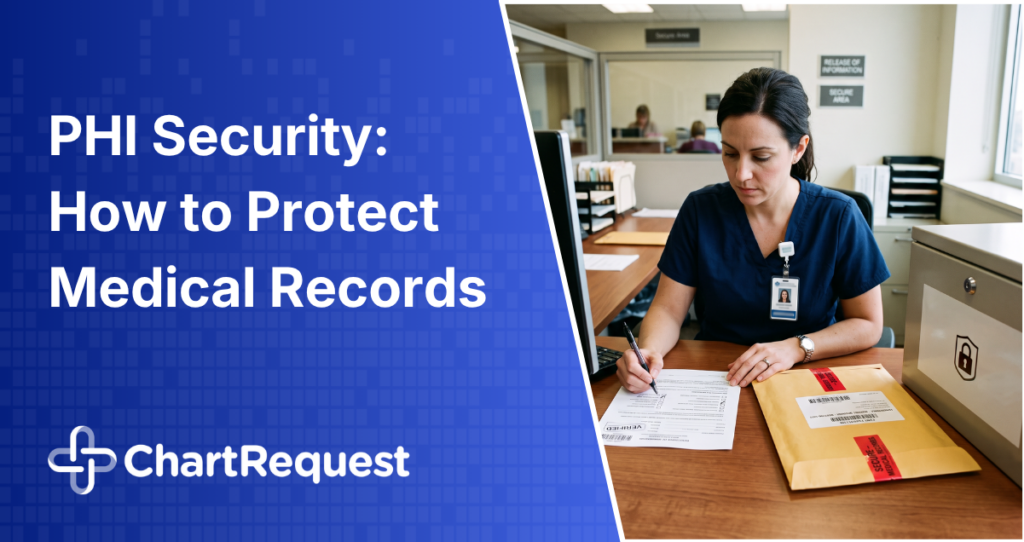
PHI security gets harder when one release moves through multiple inboxes, fax queues, spreadsheets, downloads, and systems. If HIM cannot see the request as one controlled workflow, it becomes harder to know who accessed PHI, what staff released, and where the records went.
For compliance and HIM leaders, PHI security means controlling PHI from request intake through final delivery without adding unnecessary friction.
Table of contents
- What Is PHI Security?
- What HIPAA Safeguards Protect PHI?
- How Should You Protect PHI Throughout the Release of Information Process?
- What Happens to PHI Security When ROI Is Outsourced?
- What Should You Do If PHI Is Sent to the Wrong Recipient?
- How Can Compliance and HIM Leaders Audit PHI Security Across the ROI Workflow?
- Strengthen PHI Security With ChartRequest
- Frequently Asked Questions

What Is PHI Security?
PHI security uses administrative, physical, and technical controls to protect protected health information from inappropriate access, use, alteration, loss, or disclosure.
The HIPAA Privacy Rule protects PHI broadly, while the HIPAA Security Rule applies specifically to electronic protected health information, or ePHI. PHI can also appear in paper records, request forms, fax output, and other parts of the ROI workflow. PHI security therefore has to follow the request across channels and systems, including information outside the EHR.
What HIPAA Safeguards Protect PHI?
The Security Rule organizes safeguards for ePHI into three categories:
| Safeguard | What It Means for ROI |
|---|---|
| Administrative | Roles, procedures, access management, training, risk management |
| Physical | Workstations, devices, electronic media, facility access |
| Technical | Access controls, authentication, audit controls, integrity, transmission security |
The Security Rule does not apply to PHI maintained or transmitted on paper or verbally. Under the Privacy Rule, appropriate safeguards apply to PHI more broadly.
For compliance and HIM teams, PHI security depends on those controls holding up through every handoff in the release process.
How Should You Protect PHI Throughout the Release of Information Process?
PHI security has to hold as the request moves. Teams need a control anywhere someone can access, interpret, or disclose PHI.
1. Secure Request Intake
Forms, attachments, emails, fax queues, and supporting documents can all contain PHI. Define approved intake channels and limit access to the people who need to work the request.
Scattered intake also creates version control problems. Once staff copy the same request between inboxes, folders, and spreadsheets, teams can lose track of which version is current and who still has older copies.
2. Verify Identity and Disclosure Authority
Before fulfillment starts, staff need two answers: Who is asking, and what permits us to disclose the records?
A patient Right of Access request falls under 45 CFR § 164.524, while authorization-based disclosures follow § 164.508. The Privacy Rule separately requires reasonable verification of identity and authority under § 164.514(h).
Staff should identify the correct disclosure pathway before fulfillment begins. Healthcare identity verification should confirm both who is making the request and what authority supports the release.
3. Control Access and Match the Correct Patient
Patient matching is often treated as a retrieval accuracy issue. In ROI, it is also a PHI security control.
A wrong match can expose another patient’s PHI before anything leaves the organization. Staff need enough identifying information to connect the request to the correct patient and records.
Access can also spread outside the EHR. Shared inboxes, downloaded packets, and local spreadsheets may give more people visibility than the ROI process requires. The Security Rule requires access controls and unique user identification for systems containing ePHI.
Clinical, billing, imaging, and other records may sit in separate repositories. For covered health care providers, billing records are part of the HIPAA designated record set, so teams need to know where those records live before they define release scope.
4. Confirm the Permitted Release Scope
Correct patient matching is only the first check. Retrieval can surface far more information than the request permits.
Staff should confirm the record types, date ranges, facilities, recipient, and disclosure authority that apply. The review step has to narrow the retrieved information back to what the applicable request and disclosure authority support.
Retrieval and release are separate control points. If teams treat them as one step, a complete chart can become an overbroad disclosure.
A medical records release form can support an authorization-based disclosure. Staff still need to compare the final release with the authority supporting it.
5. Verify the Destination and Protect Delivery
Many delivery failures are not sophisticated security events. They start with an email address, fax number, mailing address, or recipient being entered incorrectly.
Before sending records, confirm both the destination and delivery method. PHI security at delivery depends on safeguards that fit the request and channel, whether the team uses secure electronic delivery, email, fax, mail, or portable media.
For patient Right of Access requests, HHS says an individual may request PHI by unencrypted email after receiving a brief warning about the transmission risk and confirming that choice. Other unsecure methods may depend on the covered entity’s capabilities and the risks they create for its systems.
Email creates its own delivery risks. Teams should define safeguards for emailing medical records under HIPAA before a request reaches fulfillment.
6. Document the Disclosure
If a release is questioned later, the answer should come from the workflow rather than someone’s memory.
Documentation should show who handled the request, what verification occurred, what the organization released, where it went, how it was delivered, and when fulfillment occurred.
For systems containing or using ePHI, the Security Rule requires audit controls that record and examine system activity. HIM can then compare that activity with the request and disclosure authority when a release is questioned.

What Happens to PHI Security When ROI Is Outsourced?
Outsourcing does not remove PHI security responsibility. Asking whether a vendor says it is HIPAA compliant is only a starting point. Compliance and HIM leaders also need to know whether they can still see who accessed the request, what was released, where the records went, and how a challenged disclosure would be reconstructed.
A vendor may qualify as a business associate when it performs services involving PHI for a covered entity. When the relationship qualifies, the business associate agreement should define the permitted uses of PHI, required safeguards, reporting duties, and other responsibilities that apply to the relationship.
Compliance and HIM leaders should review four areas:
- Access: Who at the vendor can reach PHI?
- Transmission: How does PHI move through and out of the workflow?
- Auditability: Can HIM reconstruct what staff accessed and disclosed?
- Governance: Are the appropriate BAA, subcontractor, access removal, and incident processes in place?
A signed BAA establishes obligations, but it does not by itself establish strong PHI security. Vendor review should also confirm that the organization retains enough visibility to reconstruct the release.
What Should You Do If PHI Is Sent to the Wrong Recipient?
When a PHI security issue involves a misdirected disclosure, route it through the organization’s privacy or security process as soon as staff identify it. Attempt appropriate mitigation, preserve the facts needed for review, and complete the applicable breach assessment.
Under the HIPAA Breach Notification Rule, an impermissible disclosure is generally presumed to be a breach. A regulated entity can rebut that presumption by demonstrating a low probability that PHI was compromised through the Breach Notification Rule risk assessment, or if an exception applies. Recovering the records alone does not close that review.
How Can Compliance and HIM Leaders Audit PHI Security Across the ROI Workflow?
Start with five questions:
| Question | What To Review |
|---|---|
| Who has access? | Roles, permissions, inactive access |
| What permits the disclosure? | Request type, identity, authorization or other applicable basis |
| What can leave? | Record type, dates, facility, scope |
| Where is it going? | Recipient information and delivery method |
| Can HIM reconstruct it? | Users, records released, timestamps, delivery history |
If those answers are scattered across inboxes, spreadsheets, fax logs, and staff memory, PHI security oversight becomes fragmented. Routine supervision gets harder, and incident review depends more on staff recollection.
This workflow review can identify ROI weaknesses, but it does not replace the formal risk analysis required under § 164.308(a)(1)(ii)(A). A HIPAA security risk analysis evaluates broader risks and vulnerabilities to ePHI across the organization.

Strengthen PHI Security With ChartRequest
A strong ROI workflow should make PHI security visible at each control point: who accessed the request, what left the organization, where it went, and what the team can reconstruct afterward.
ChartRequest helps healthcare organizations move release of information into a controlled workflow with request-level visibility and a detailed audit trail of request activity. Teams can keep ROI in-house or use our experts for fulfillment while maintaining visibility into the process.
Schedule an ROI workflow review to identify where disconnected tools or manual handoffs are creating avoidable PHI security risk.
Frequently Asked Questions