




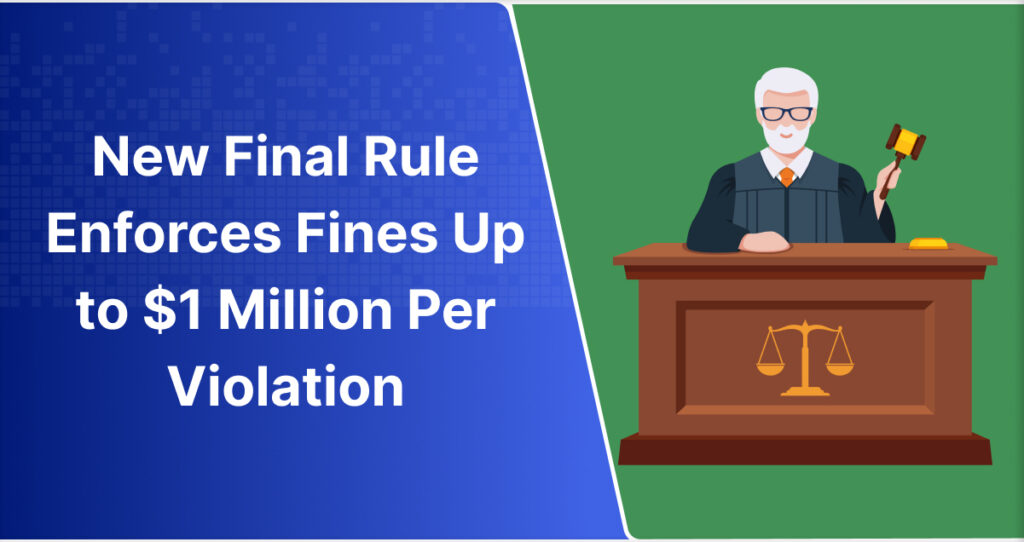
On June 27, 2023, the Department of Health and Human Services (HHS) Office of Inspector General (OIG) posted a new information blocking final rule. This rule imposes financial penalties of up to $1 per violation, as mandated by the 21st Century Cures Act.
HHS defines information blocking as “a practice by an ‘actor’ that is likely to interfere with the access, exchange, or use of electronic health information (EHI), except as required by law or specified in an information blocking exception.”
Compliance with the Cures Act is simple in theory, but there are a lot of factors to keep in mind. For example, to prevent any potentially harmful releases of PHI in fear of these penalties, the Cures Act includes 8 information blocking exceptions. Additionally, compliance requires the ability to share PHI in an electronic format.
Now, we’ll provide a summary of the new final rule and cover the key facts. If you’re a healthcare professional, it’s especially important to understand what the new information-blocking final rule means for you.
To Whom Does the New Information Blocking Final Rule Apply?
The new information blocking final rule specifically targets organizations that develop health IT software and networks. The new final rule applies to:
- Developers of certified health IT
- Organizations that offer certified health IT
- Health information exchanges
- Health information networks
If you’re a healthcare professional, you may be thinking, “Great, this new information-blocking final rule doesn’t apply to me!” While this is technically correct, it’s not the whole truth.
In the new information blocking final rule announcement, OIG stated that HHS is working on a separate rule for providers. The financial penalty structure outlined in the 21st Century Cures Act is nothing new. However, if your organization is not yet confidently compliant with the Cures Act, this should serve as a reminder.
OIG will enforce these penalties 60 days after publication of the new information blocking final rule in the Federal Register. They have already submitted the final rule to the Federal Register and are awaiting publication.
In the meantime, OIG won’t impose penalties for information blocking. This should ideally give health IT professionals extra time to audit and fix any existing compliance issues.
While 60 days may sound like plenty of time, the Cures Act is a dense legal document spanning 312 pages. With the separate healthcare provider rule incoming, it’s important to understand your current state of Cures Act compliance.
You don’t want to wait until you only have 60 days left to sort out your Cures Act compliance. Check out key ChartRequest features that can help you prevent information blocking and ensure compliance with state and federal regulations.
How Will the OIG Investigate Information Blocking Claims?
Reporting information blocking claims is easy, and many requestors may not accurately understand the intricacies of the Cures Act. As such, the OIG anticipates a higher volume of information-blocking claims than they can feasibly investigate.
To ensure they can address major information-blocking issues, the OIG outlined which types of cases are high-priority. OIG will prioritize cases that:
- Is, has, or could harm the patient
- Detrimented a provider’s ability to provide patient care
- Continued for a long time
- Financially impacted government or private entities
- Knowingly involved information blocking
Additionally, OIG outlined the process they will follow for each information-blocking claim they investigate under the new final rule. When OIG selects a case for investigation, they will gather information, conduct interviews, and document the situation before discussing the investigation with the accused entity.
If the investigation reveals the entity committed information blocking, OIG will send them a demand letter. The entity may then appeal the penalty if they believe the investigation is incomplete, incorrect, or too severe.
While OIG outlined this process for health IT entities, it’s likely that the process for investigating healthcare professionals will match. As always, in the case of an investigation, cooperation, and action are crucial for minimizing penalties.
Do You Need Help With Cures Act Compliance?
ChartRequest is a release of information and care coordination software designed to make ROI secure, efficient, and easy. As such, we are a Health IT organization directly responsible for compliance with the new information blocking final rule.
We believe that the release of information shouldn’t be difficult for healthcare providers or their requestors. Unfortunately, the regulations that protect patient privacy and data security also make the process complicated.
We are dedicated to simplifying ROI compliance and providing the information healthcare providers need most. In fact, ChartRequest CEO Chris Carter recently spoke about information blocking and cures act compliance for WSHIMA 2023.
By using ChartRequest to eliminate common ROI frustrations like fax failure, constant phone calls, and even staffing challenges, healthcare providers can ensure lasting compliance and focus on providing an excellent patient experience.
ChartRequest has the expertise to help your organization avoid penalties from the next information-blocking final rule. Our omnichannel support and user-friendly design have helped us achieve an average rating of 4.8 stars on Google reviews.
Want to learn more? Set up your brief demo, and we’ll be happy to assess and discuss your organization’s release of information compliance needs.