





A questionable medical record fee does not necessarily mean the records request has stopped. The fee and the production can move on separate tracks, so a corrected invoice still does not tell you whether the provider is processing the records.
That is the first thing to establish before you pay, challenge the charge, or send another request.
Questions about attorney request for medical records fees depend on the request pathway, governing fee rule, provider, production format, and scope. Before you act on the invoice, determine what the provider charged for and what is happening with the records.
Keep fee status and production status visible from that point forward. You need to know what still has to happen with the invoice and what still has to happen with the records.
Table of Contents

How Much Can an Attorney Be Charged for Medical Records?
There is no single nationwide fee schedule for every attorney request for medical records fees. Evaluate the amount under the framework that applies to the provider and request.
The Illinois medical record copying fee schedule includes a handling charge, tiered page charges, and separate treatment for electronic records. Rhode Island uses a different structure. Its physician medical record rule expressly covers authorized third-party requests from attorneys and allows actual postage.
That is why an attorney request for medical records fees cannot be evaluated from the dollar amount alone. Check the fee against the governing framework, requested scope, and expected production.
Provider Record Fees vs. Retrieval Service Fees
Keep provider charges separate from the cost of managing retrieval.
Provider or custodian fees are charges tied to producing the records. Retrieval service fees come from a vendor for the work included in its service. That work may include submission, tracking, provider follow-up, and delivery.
If those costs are combined, you may know the total without knowing whether the provider charge or retrieval service created the difference.
Does HIPAA Limit Attorney Request for Medical Records Fees?
A signed HIPAA authorization does not automatically make an attorney request subject to HIPAA’s individual access fee limitation.
Under 45 CFR §164.524, an individual generally has a right to inspect and obtain a copy of protected health information in a designated record set. For a copy requested under that right, §164.524(c)(4) permits a reasonable, cost-based fee limited to specified expenses.
Attorney involvement does not determine whether that framework applies. Following Ciox Health v. Azar, HHS states that the §164.524(c)(4) fee limitation applies to an individual’s request for their own records. It does not apply when the individual asks the covered entity to transmit records to a third party. The HHS post-Ciox Right of Access notice explains that limitation.
HHS separately explains that the fee limitation does not apply when a third party initiates its own request using the individual’s HIPAA authorization. HHS guidance on third-party requests and access fees addresses that distinction. 45 CFR §164.508 separately addresses HIPAA authorizations for uses and disclosures.
The often-repeated “$6.50 HIPAA cap” needs the same caution. HHS guidance on the $6.50 flat-fee option describes it as an optional calculation method for certain electronic copies requested by an individual. It is not a universal medical record fee ceiling.
Identify the request pathway before applying a HIPAA fee limitation.
How Should a Law Firm Audit a Medical Record Fee Before Challenging It?
Start with the request, not the total at the bottom of the invoice.
For an attorney request for medical records fees, answer two questions. Does the charge reconcile? Does resolving it change what happens next with the records?
| Check | What to Verify | What to Keep |
| 1. Request pathway | Individual access, authorization, subpoena, court order, or another process | Request and supporting authority |
| 2. Provider and jurisdiction | Entity holding the records and current fee authority | Provider information and fee source |
| 3. Scope | Date range, clinical records, billing, imaging, certification | Original request |
| 4. Quantity and format | Pages, files, paper, electronic records, imaging | Quote, notice, or invoice |
| 5. Fee basis | Copying, processing, postage, media, certification, or other charges | Itemized calculation and fee authority |
| 6. Prior activity | Previous invoices, payments, productions, duplicate orders | Receipts and request history |
| 7. Production status | Whether records are moving, waiting, or complete | Follow-up notes |
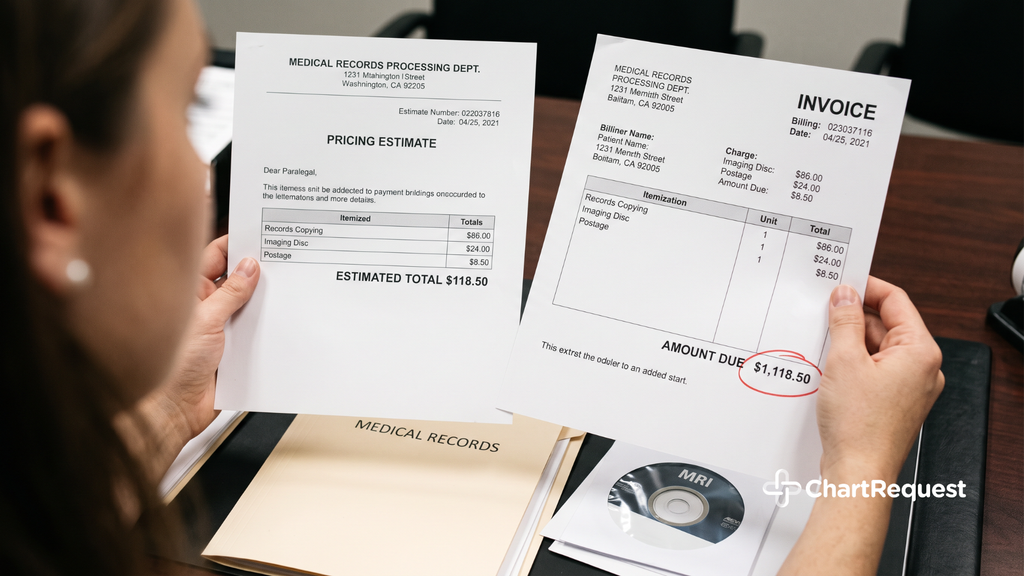
First identify what landed in front of you. An estimate, payment notice, and final invoice require different checks.
An estimate reflects the anticipated production. A payment notice may identify an issue to resolve before the request advances. A final invoice should reconcile with what the provider actually produced.
Look for a defined mismatch. Check the page count, production format, duplicate charges, unrequested certification, and the rate applied to the request.
If everything reconciles, you probably have an approval decision. If it does not, you have a specific question for the provider. A mismatch is a reason to investigate, not proof of an unlawful fee.
How Do You Dispute a Medical Record Fee Without Delaying the Request?
When disputing attorney request for medical records fees, make the provider follow-up specific.
Ask for the page or file count, production format, added charges, and the fee schedule or authority used to calculate the invoice.
“This fee seems too high” leaves the provider to identify the problem. A defined discrepancy gives the provider something concrete to review.
If the invoice needs correction, ask whether the provider can update it against the existing request. Keep the exception in the same request history. Store the request, quote or payment notice, invoice, payment record, provider correspondence, and final production together.
Then track two statuses. Fee status tells you what still needs to happen with the invoice. Production status tells you what still needs to happen with the records.
A fee question should not create another authorization, submission, queue position, or round of provider outreach unless those steps are required.
This is where an invoice exception becomes retrieval work. Someone still has to maintain the history, follow up, identify what is holding production, and escalate when the request stops moving.
Can a Provider Hold Records While a Fee Is Being Reviewed?
Once you document the fee question, find out whether it changes when you will receive the records.
For an individual exercising the HIPAA right of access, 45 CFR §164.524 generally requires a covered entity to act within 30 days after receipt. The regulation permits one extension of no more than 30 additional days when its conditions, including written notice, are satisfied.
An attorney-initiated request under a different authorization or legal process needs its own timing analysis.
For the request in front of you, determine whether the applicable framework permits payment before production. Also identify any response or production deadline.
Before you close the follow-up, answer four questions. Is the request active? Is payment preventing production? What deadline applies? Who has the next action?
That is the information you need when someone asks, “Where are the records?”
How Can Law Firms Prevent Repeat Medical Record Fee Problems?
The next fee exception should not require another case manager to start from zero.
To avoid repeat questions about attorney request for medical records fees, capture the provider, request pathway, requested dates and record types, production format, and certification requirements while the request is active. Keep estimates separate from final invoices and payments so the next person can see where the cost changed.
Retain useful provider billing history, but verify the current fee authority instead of treating an older invoice as the governing rate. Before opening another order, check for an active or completed request covering the same provider and scope.
Our medical record retrieval services for law firms comparison covers the broader workflow, including provider follow-up, billing and imaging gaps, and status visibility.
When Does a Fee Exception Become a Retrieval Workflow Problem?
One questionable invoice may create one additional task. A recurring pattern is different.
When questions about attorney request for medical records fees send you back to old notes, fee schedules, provider calls, and corrected invoices, the work has moved beyond invoice review.
The person managing the request is still responsible for getting the records into the file. They do not control when the provider answers or production resumes, but they still have to provide the next status update.
A better retrieval workflow removes more of the provider chase required to get that answer.

Take Provider Follow-Up Off Your Legal Team With CaseBinder
One invoice should not cost you another afternoon of old notes, provider calls, and status checks.
With CaseBinder, our retrieval experts handle provider follow-up and escalate when necessary. Your team keeps visibility through centralized tracking and real-time status updates.
See how CaseBinder could fit your medical record retrieval workflow and where we can take more provider follow-up off your legal team.
Frequently Asked Questions
Who Pays Medical Record Fees in a Legal Case?
There is no universal answer. Responsibility can depend on the firm’s client agreement, applicable professional rules, jurisdiction, and circumstances of the matter. Keep that question separate from whether the provider has support for the charge.
Can a Provider Charge for Electronic Medical Records?
Potentially. The request pathway and governing fee rule control the answer. Under HIPAA’s individual access framework, §164.524(c)(4) permits only specified reasonable, cost-based expenses. Electronic delivery does not make every attorney request free.
Can a Provider Charge a Search or Retrieval Fee?
For an individual exercising the HIPAA right of access, allowable copying labor does not include searching for and retrieving responsive PHI. HHS guidance on allowable copying labor explains that copying labor begins after the covered entity identifies and retrieves the responsive PHI.
What Should I Do if a Provider Will Not Explain a Medical Record Fee?
Ask for an itemized calculation and the fee authority the provider is applying. At the same time, confirm what is happening with production. If the disagreement turns on legal interpretation rather than a billing or calculation error, route it to the firm’s appropriate reviewer.
Should I Submit a New Records Request When Disputing a Fee?
Not as the default response. First confirm whether the current request remains active and whether the provider can clarify or correct the invoice against it. Starting again when you do not need to can create another order, request history, and round of provider follow-up.