
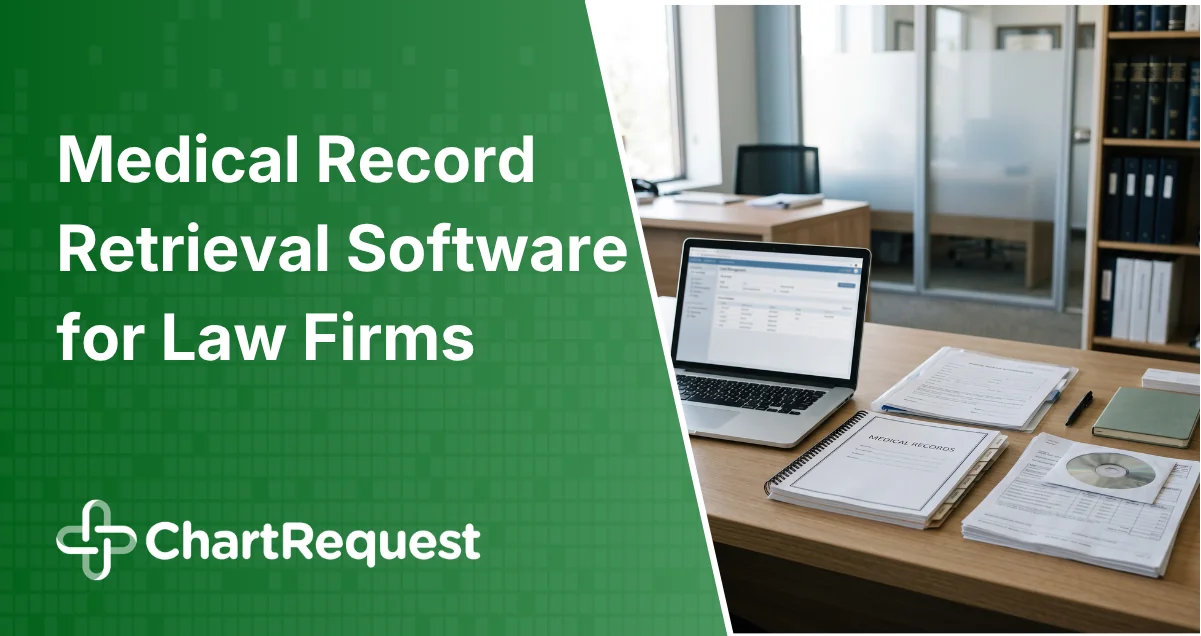


Law firms usually look for medical record retrieval software when retrieval consumes too much staff time. Paralegals and case managers may spend hours requesting records, checking status, and following up with providers.
Law firms generally choose among three retrieval models: in-house, self-service, or managed retrieval. Managed retrieval pairs technology with retrieval experts who handle more provider follow-up.
Depending on the platform and service model, medical record retrieval software can reduce recurring manual work. That includes duplicate entry, status checks, authorization rework, and provider follow-up.
Before looking at features, identify which retrieval tasks are consuming the most staff time.
Table of contents
- What Is Medical Record Retrieval Software for Law Firms?
- What Can Medical Record Retrieval Software Automate?
- What Is the Difference Between In-House, Self-Service, and Managed Retrieval?
- Which Medical Record Retrieval Software Features Matter Most?
- How Does CaseBinder Make Medical Record Retrieval Easier?
- Frequently Asked Questions

What Is Medical Record Retrieval Software for Law Firms?
Medical record retrieval software helps law firms request, track, receive, and manage medical and related records from healthcare providers.
It is different from case management software, which organizes the broader legal matter. It is also different from an electronic health record system, which providers use to manage patient information. Retrieval software focuses on obtaining requested records and managing the workflow around that request.
Retrieval software is also distinct from medical record review or summarization software. Some platforms use AI to support provider identification or request routing. Others also bundle downstream functions such as classification, chronology, summarization, or record analysis. Those downstream capabilities solve a different problem from the core retrieval workflow.
Depending on the platform, retrieval software may support request creation, electronic authorizations, provider identification and routing, status tracking, and follow-up. It may also support secure delivery, reporting, and case management integrations.
What Can Medical Record Retrieval Software Automate?
Medical record retrieval software can automate or centralize many repetitive parts of the request process. Common examples include request creation, authorization collection, provider routing, status updates, reminders, document delivery, and reporting.
The software may also move request data between connected systems and reduce duplicate entry.
The value increases when those steps work together. Matter and provider information can move into the request without being entered again. Authorization documents can stay tied to the request. Status can be visible without searching email or calling for an update. Completed records can return to the same workflow instead of creating another manual handoff.
Automation still has limits. A provider may reject an authorization, require a different process, fail to respond, or route billing and imaging separately. A dashboard can show that a request has stalled without actually moving it forward.
That is why the service model matters as much as the software itself. Self-service software can make the process easier to organize. Managed retrieval can also reduce the provider follow-up and escalation work that would otherwise stay with your staff.
If your firm is considering medical record retrieval automation, understand which steps technology can handle and where human retrieval support still makes a difference.
What Is the Difference Between In-House, Self-Service, and Managed Retrieval?
The role of technology changes depending on how your firm runs retrieval.
| Model | Role of Technology | Role of Your Staff |
|---|---|---|
| In-House Retrieval | Existing internal tools support tracking and administration | Your staff manages the retrieval process |
| Self-Service Retrieval Software | Dedicated software standardizes requests, authorizations, tracking, and related workflow | Your staff handles more of the retrieval process and provider follow-up |
| Managed Records Retrieval | Platform supports submission, status, and delivery while retrieval experts handle more provider follow-up and escalation | Your staff maintains visibility with less routine provider follow-up |
The distinction matters because two firms can both use medical record retrieval software and still have very different staff workloads.
A self-service platform can replace spreadsheets, centralize request information, and give your staff better visibility. That can be a meaningful improvement when the main problem is organization. But provider calls, authorization corrections, status follow-up, and routine exceptions may still remain with your paralegals.
Managed retrieval changes more of the operating model. Your staff still has visibility into the request, while retrieval experts handle more provider communication and escalation. For firms looking to move more of that work outside the firm, the difference between medical record retrieval services often comes down to how much of the retrieval process the service actually takes over.
That workload also affects medical record retrieval cost. Software fees and per-request charges are only part of the picture when your staff is still spending time on calls, status checks, and request corrections.

Which Medical Record Retrieval Software Features Matter Most?
The most useful features reduce recurring retrieval work.
| Capability | What a Better Workflow Should Do | How It Reduces Staff Work |
|---|---|---|
| Request and Authorization Workflow | Carry reusable matter and provider information into a consistent digital request process | Less re-entry and avoidable correction work |
| Provider Identification, Coverage, and Request Routing | Help identify the right custodian across the providers and record types your firm regularly requests from | Less provider research and fewer misdirected requests |
| Status Tracking | Show current status, aging, next steps, and completed items in one place | Fewer manual status checks and internal interruptions |
| Follow-Up and Escalation | Keep routine outreach moving and address stalled requests based on the service model | Less manual provider follow-up |
| Case Management Integration | Move request and record data between systems without repeated entry | Less duplicate work and file movement |
| Security and Access Controls | Support encryption, role-based access, audit trails, secure transmission, and documented security controls | Less reliance on disconnected methods for sending and accessing sensitive records |
| Reporting | Show request volume, aging, turnaround, open issues, and completion | Less manual reporting and status reconstruction |
These capabilities are most valuable when they work together.
An integration has limited value if your staff still has to re-enter the same request information somewhere else. Real-time status is more useful when it shows what is actually happening with the request, not just that it remains open. Follow-up tools matter most when they reduce the number of calls and manual reminders your staff has to manage.
Authorization workflows also need to do more than collect an electronic signature. When a provider relies on a HIPAA authorization, the workflow should help your staff collect the required information before submission. Under 45 CFR §164.508, a valid authorization must include defined core elements and required statements. An electronic signature alone does not establish that the authorization is complete.
The same principle applies across the workflow: a feature is useful when it removes friction rather than creating another place for your staff to manage the same task.

How Does CaseBinder Make Medical Record Retrieval Easier?
We designed CaseBinder for law firms that want retrieval technology without keeping routine provider follow-up on their own staff.
Your team can submit requests through one platform, use electronic authorization forms, and watch progress in real time. Our retrieval experts handle provider follow-up and escalation, so your staff spends less time managing routine provider outreach.
That changes the daily workflow. Your paralegals can see request progress in one place instead of piecing status together across separate retrieval touchpoints. They can receive completed records in one platform and spend less time managing the retrieval process around the case.
You can get your records faster, know where each request stands, and spend less time managing retrieval.
If your paralegals are spending too much time calling providers, checking status, or managing request administration, schedule a personalized consultation. See how CaseBinder can help your staff get records faster with less manual follow-up.
Frequently Asked Questions
What Is Medical Record Retrieval Software for Law Firms?
Medical record retrieval software helps law firms request, track, receive, and manage medical records tied to legal matters. Depending on the platform, it may also support electronic authorizations, provider identification and routing, follow-up, secure delivery, reporting, and case management integrations.
What Features Matter Most in Medical Record Retrieval Software?
The most useful features reduce recurring staff work. That can include stronger request and authorization workflows, provider identification and routing, real-time status visibility, follow-up support, case management integrations, security controls, and reporting. The value comes from making the retrieval process easier to run, not from adding more tools for staff to manage.
Does Medical Record Retrieval Software Handle Provider Follow-Up?
Some medical record retrieval software automates reminders or electronic outreach while leaving provider communication with your staff. Managed retrieval goes further by pairing the software with retrieval experts who handle more routine follow-up and escalation.
What Is the Difference Between Self-Service Software and Managed Retrieval?
Self-service retrieval software gives your firm technology to organize and manage more of the retrieval process internally. Managed retrieval combines software with service support, so your firm keeps visibility into request status while more provider follow-up and escalation move outside your staff’s workload.
How Can Medical Record Retrieval Software Reduce Paralegal Work?
Medical record retrieval software can reduce duplicate entry, manual status checks, authorization rework, file movement, and other repetitive request tasks. Under a managed model, it can also reduce the provider follow-up and escalation work that would otherwise stay with your paralegals.