ChartRequest is Proudly Partnered With


Medical records contain personal information that cybercriminals covet. As such, your practice is responsible for ensuring that protected health information (PHI) stays safe.
The regulations set by the Health Insurance Portability and Accountability Act (HIPAA) and the HITECH Act aim to keep PHI confidential. These constraints regulate the safe storage and exchange of medical records.
While there is no single right way to release medical records, there are wrong ways.
Using potentially unsafe methods increases the risk of HIPAA violation, which can include hefty financial penalties. Fortunately, there is a solution your practice can implement for maximum compliance.
Partner with ChartRequest today.
What Is Medical Record Release Software?
Vendors design medical records release software to facilitate the secure exchange of personal identifiable information (PII). Companies that specialize in health information exchange (HIE) should stay current with the latest HIPAA compliance requirements.
While standard release methods can vary in compliance and security, medical records release software aims to standardize the process.
What To Consider When Insourcing Medical Record Release
If you’ve found your way to this article, chances are you’re not pleased with your current release of information (ROI) process. Whether you lack ROI software integration into your practice or you’re using one that doesn’t put you first, we’re here to help.
When choosing your new medical records release solution, you should measure twice and cut once. Do some research before you make your decision, and look into the following factors:
Which Platforms Are HIPAA Compliant?
When shopping for a record release solution, non-compliance is an immediate deal-breaker. Companies should not only adhere to the bare minimum but also make an active effort to stay up-to-date on the latest regulatory changes.
Can You Use Your Own Staff?
Some of the leading software options require you to outsource the release of information to their staff. ChartRequest gives you the option to streamline the process in-house.
How Quick Is Record Turnaround?
A significant benefit of using high-quality software is speeding up the health information exchange process on both ends.
What Do You Need for Record Release Software?
Before implementing a new software solution, you should prepare your staff and IT department.
Ask yourself a few questions before you commit, such as:
- How many requests does your practice receive every month?
- How many employees currently process medical records requests?
- How do you currently release medical records?
You should be sure to have all relevant organizational information available before creating your account with a records vendor.
What Does Onboarding Look Like?
Let’s use a real-world example to better understand onboarding with a records exchange provider. Partnering with ChartRequest is fast and easy. You only need to follow a few steps to set up a release custodian account.
Here’s an example onboarding process:
- Create Your Account: Create login credentials for your account. A member of our team will verify your information.
- Submit the Onboarding Form: This form will request information specific to setting up your custodian account with the necessary authorizations.
- Schedule a Software Demo: This step showcases how the platform works and allows you to ask our experts questions.
- Create a ChartRequest Button On Your Website: A visible button helps requestors navigate to your ChartRequest portal without confusion.
This streamlined process is preferable to traditional staff training methods on new software.
How Does Record Exchange Software Affect Patients?
A patient account can function as a repository of medical records and forms for multiple people. Our platform lets patients save medical record release authorization forms for each individual.
Once a patient creates their ChartRequest account, they can submit their first request. In addition to medical records, patients can request school, camp, and disability forms with ease. From start to finish, creating a request takes just a few minutes.
Patients can check which stage of the process their request is in at any time. These updates are in real-time and accessible via any secure mobile device or computer.
ChartRequest will automatically keep released records on file for 30 days for the patient.
If patients want to maintain their records indefinitely, they can check out Store and Share. This option also allows patients to provide their doctors with medical records anytime.
How Does This Change Affect Your Team?
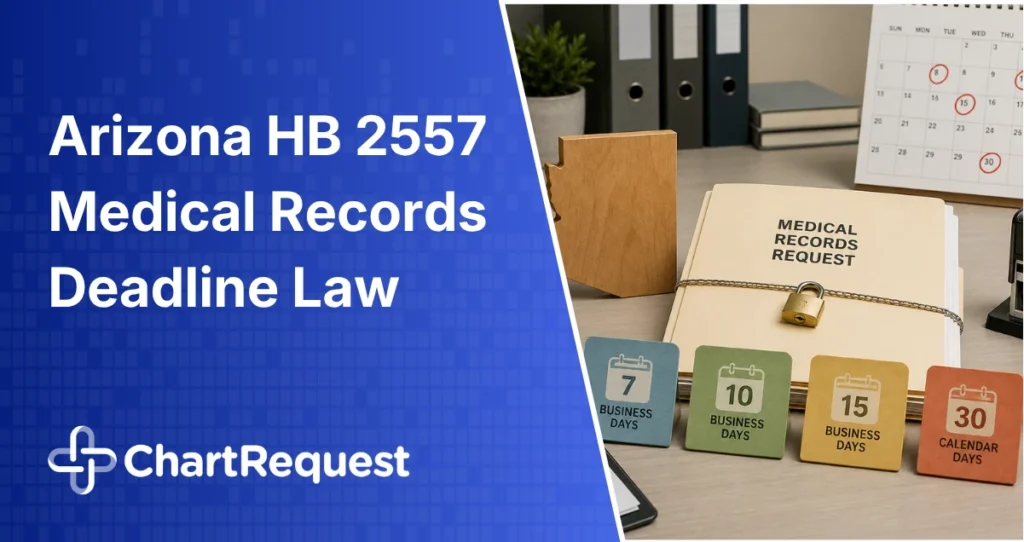
Your staff must keep up with incoming medical records requests to avoid HIPAA violations. Remember, most states require you to respond to medical records requests within 30 days of receiving the request.
Here are the seven stages of releasing medical records:
- Draft: Any new request will begin as a drafted form.
- Pending: New requests submitted to your office are pending until your team can verify that the authorization form and information provided are correct.
- Incomplete: Return any incorrect and incomplete requests for correction.
- QA: Once your team retrieves the requested records, ChartRequest will slate them for a quality assurance review.
- Priced: ChartRequest will verify state-by-state pricing for release to your requestor.
- Ordered: Completed payments will prompt the transfer of requested records.
- Completed: All documents arrive complete and on time.
This centralized approach allows each member of your team to pick up where the last left off. To protect your organization, we keep track of every single interaction with each request with our automated audit log.
Top Benefits of Insourcing Record Release With Software
Not all vendors allow the in-house release of medical records. While outsourcing the entire task to professionals is a great option, it shouldn’t be the only option.
ChartRequest is for healthcare organizations of all sizes and operations. Our healthcare partners range from small, single-provider offices to urgent care centers with multiple locations. We understand that medical specializations and patient volume impact how many medical records requests your practice receives.
If your practice doesn’t receive many requests, the time investment of using ChartRequest to process them should be low. Using our platform for in-house medical records release is the more cost-effective option.
Your staff can also save valuable administrative hours. In fact, healthcare users can save up to two hours per request! With that time, your team can focus on what matters most — providing the best care possible to patients.
Ready to take the next step? Discover which ChartRequest solution is the best fit for your organization.
Facebook
Twitter
LinkedIn
Stay Updated
100% Privacy. No spam guaranteed.