ChartRequest is Proudly Partnered With


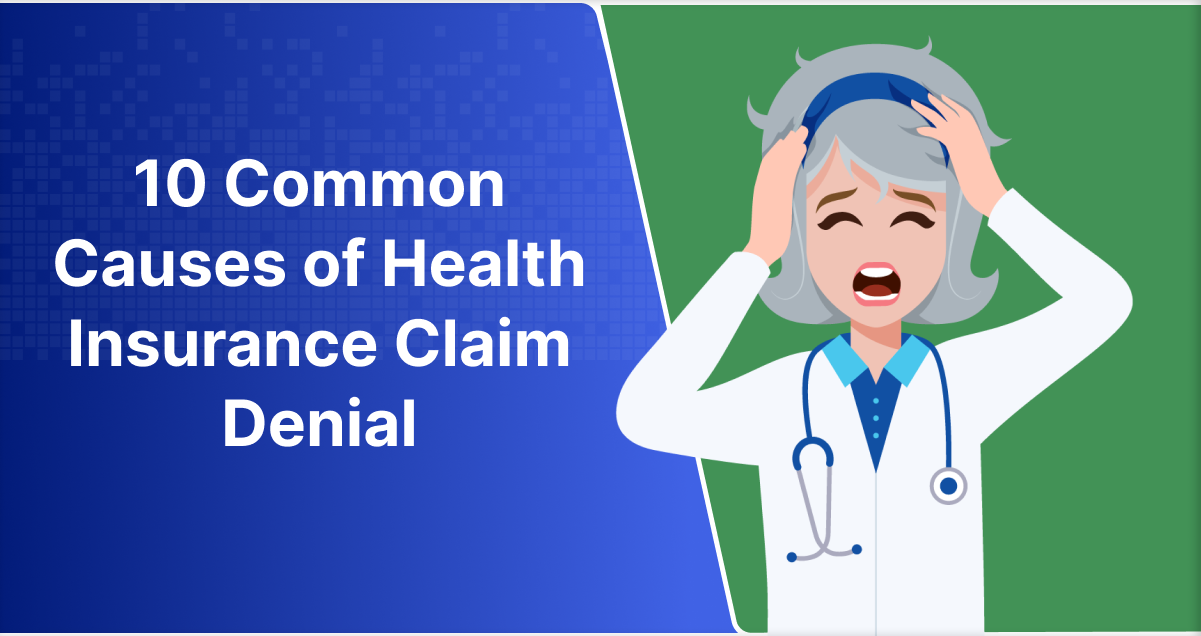
If you or a patient has a health insurance claim denied, it can be frustrating figuring out the issue. This article aims to provide clarity by explaining some of the most common reasons.
Great healthcare can offer patients a greater peace of mind, but this security can be dauntingly expensive. Health insurance shields patients from those costs, acting as a financial backup plan for when life throws a curveball at a patient’s health.
Now, here’s a less cheerful fact: sometimes, health insurance claims are denied. Imagine feeling relieved that you’re done providing care, only to get hit with a ‘claim denied’ notice. Ouch!
During the first quarter of 2023, commercial payers denied 15.1% of inpatient and outpatient claims. That’s way more than Medicare’s denial rate of 3.9% in the same time frame! When a health insurance claim is denied, it can add financial stress to an already stressful time.
In this article, let’s talk about the 10 reasons that can get a health insurance claim denied. We’ll also discuss how ChartRequest can help cover your bases. It’s a great tool for getting all the medical records you need, fast and safe. Protected Health Information (PHI) records are crucial for when you need to challenge a denied claim.
With all the right documents, ChartRequest helps you make a stronger case! You can also directly talk to our Release of Information (ROI) process experts for a free demo and consultation.
What Is Health Insurance?
At its core, health insurance is like a safety net that catches individuals financially if they slip and fall into extreme healthcare costs. Think of it as their financial buddy who steps up to the plate when a patient needs medical attention.
As of 2022, a whopping 304 million people in the U.S. had health insurance according to Statista. That’s a hefty 92.1% of the population! It seems like a lot of people don’t want to play financial roulette when it comes to their health.
Now, let’s break it down. There are several types of health insurance plans out there:
- Employer-provided plans – This is the bread and butter for most folks, where the job provides health insurance as part of an employee’s work benefits.
- Private individual plans – Private insurance is the way to go for the self-employed or those without employer coverage.
- Medicare – The trusted friend of the 65 and older crowd and younger people with certain disabilities.
- Medicaid – This one’s for the low-income group, providing necessary coverage often at no or low cost.
- CHIP – Standing for Children’s Health Insurance Program, CHIP focuses on, you guessed it, the kiddos, especially in families that earn too much to qualify for Medicaid but still need help.
- Military coverage – A salute to TRICARE and the Veterans Health Administration for providing coverage to our service members and veterans.
Benefits of Health Insurance Coverage
The benefits of walking arm-in-arm with health insurance are easy to see. For starters, people won’t get cold feet when seeing a doctor because they have less anxiety over the costs.
Regular check-ups? Covered.
Prescriptions? Handled.
That unexpected trip to the emergency room because you decided to test if gravity still works? They’re not alone in facing that bill.
Essentially, health insurance prevents a financial downpour from ruining a person’s day when physical or mental health issues arise. However, when a health insurance claim is denied, it can throw a wrench into the machine.
So, while health insurance might sound like a lot of homework, it primarily exists as a buffer against medical money meltdowns. Because let’s face it, life’s much better with fewer financial worries – particularly when it comes to staying healthy and happy.
Health Insurance Claim Can Be Denied — Here Are 10 Reasons
Hang tight, ’cause we’re about to dive into your least favorite subject – when a health insurance claim is denied.
Think of a claim as a patient’s personal request to their insurance company, saying, “Hey, I paid my dues, now it’s time to hold up your end of the bargain for my medical expenses!”
But sometimes, insurance companies shake their heads and say, “Nope” to that claim – that’s a health insurance claim denial. And boy, it isn’t just an ‘oops’ moment!
In 2022, denials rose to a whopping 11% of all claims, an increase of nearly 8% from 2021.
That sort of spike can put anyone on edge. Now, let’s understand why health insurance claim denials happen and how you can arm yourself against them.
Ready to play claim defense? Let’s get the ball rolling!
1: Incorrect Patient Information
Ever punched in the wrong digits when ordering pizza and ended up hungry and waiting? Now imagine a typo causing a health insurance claim denial.
Here’s the scoop: about 35% of all denied health insurance claims come from getting patient details wrong or leaving them half-baked.
Claim payments can nosedive because of simple slip-ups like:
- Using a patient’s nickname instead of their legal name
- mixing up numbers on a patient’s birth date
- Zipping past the insurance ID field or mixing up the digits
How can you get fewer health insurance claims denied?:
- Double, no, triple-check patient information every time you submit it.
- Keep all documents organized and ready – a digital Health Information Management tool does wonders.
- Healthcare providers or insurers can miss one detail, so make a habit of confirming all information
Release of information tools like ChartRequest help healthcare providers and insurers manage medical records with less hassle. By easily requesting and receiving crucial patient records, you can submit stronger claims and prepare for another attempt for reimbursement after a health insurance claim denial.
Keeping your patient’s medical information accurate isn’t just paperwork—it’s vital for your health insurance claims from being denied.
2: Out-of-Network Provider
Let’s chat about this whole ‘network’ thing in health insurance.
Imagine you’ve got a squad of doctors, hospitals, and clinics that an insurance company gives a thumbs up to — that’s a network. They have deals with insurance providers, meaning patients pay less out-of-pocket when they stick with them.
Now, if a patient steps out of that circle and sees someone ‘out-of-network,’ they’re basically on their own. The insurance company might cover a tiny part, or sometimes, nada. Zilch.
It can be frustrating when an out-of-network health insurance claim is denied because there’s little recourse.
Before booking an appointment, the following tips can help prevent out-of-network health insurance claim denials:
- Check insurance cards: They usually list if a plan is a PPO, HMO, or another type of plan. These letters are your secret code to know the network situation.
- Visit the insurer’s website: They should have a directory that lists in-network providers.
- Keep a list of in-network insurance companies: You can prevent patient headaches if you have network status available for quick responses.
3: Non-Covered Services
Next, let’s talk discuss non-covered services. Expecting all insurance companies to cover all services is like expecting a slice of cheesecake with every meal; sometimes, it’s just not on the menu!
So, what’s usually not covered by health insurance that can catch your patients off guard? In many cases, cosmetic procedures, alternative therapies, and routine dental or vision care could be out-of-pocket for your patients.
Now, you might be thinking, “But wait, I’ve seen folks get these covered before!” And you’d be right—some plans might offer coverage, but a staggering 62% of bankruptcies in the U.S. are due to medical expenses, and not knowing what a plan includes can definitely contribute to that. Ouch!
To safeguard savings, here are some pro-tips:
- Ring up the insurance provider: A quick conversation can clarify what’s covered and what’s not
- Examine policy details: They should list everything that’s included, plain and simple
- Get pre-authorization: This is the golden ticket, making sure the cost is approved before you commit to treatment
Knowing what your patient’s insurance policy covers is not just being nitpicky—it’s being smart. So, do the legwork and make sure you won’t be left with a bill that’ll have you seeing double!
4: Lack of Prior Authorization
Prior authorization is like that permission slip for school field trips—it’s an insurer saying, “Yep, we got you covered for this specific procedure.” When doctors suggest certain tests, procedures, or medications, the insurance company will want to verify whether it’s medically necessary.
Skipping this step is like trying to board a plane without a boarding pass — you’re probably not getting on. It’s a common reason for claim denials, and here’s the kicker: nearly 24% of prescription claims require prior authorization for reimbursement.
Remember, waiting for an insurer’s nod can feel like watching paint dry, but it’s crucial for covering costly services. Don’t let the lack of prior authorization be the hurdle that trips up your claim game. Stay informed, and you’ll glide through the insurance maze with ease!
5: Late Filing of Claim
Managing healthcare billing is like running a race with hidden hurdles — the trickiest obstacle is the dreaded filing deadline for insurance claims. Tick-tock! These deadlines are often set in stone by insurance providers, and missing them is a surefire way to see a claim turned down faster than you can say “What’s the cutoff again?”
Here’s why prompt filing is a big deal:
- Insurance companies typically mandate a filing window, often 90 to 180 days from the date of service.
- Late submissions are viewed as a sign of administrative oversight, raising red flags and often resulting in outright denials.
- A staggering up to 25% of healthcare revenue is lost due to inefficient billing processes.
To steer clear of the late-filing pothole, healthcare providers can pump up their proactive powers:
- Keep an eye on the clock: Track and record the date of service and the deadline in your billing system.
- Embrace technology: Tools like ChartRequest can be saviors, streamlining the process by handling information with speed and precision.
- Set reminders: Whether it’s through software or a good old sticky note, reminders can be lifesavers.
Remember, the key isn’t just fast legs, it’s staying ahead in the race against the insurance clock.
6: Unnecessary Medical Services
Insurance companies have a keen eye for what they term ‘medical necessity.’ It’s their rulebook for determining whether a healthcare service is essential for the patient’s diagnosis or treatment. Providers may see their claims denied if a service is deemed unnecessary, leaving them and their patients in a bind.
A study reveals that up to 30% of US healthcare spending may be unnecessary. Insurers expect clear evidence that a service is crucial for a patient’s well-being, so maintaining thorough documentation is important.
Here are some tips to help providers communicate more effectively:
- Get crystal-clear on criteria: Make sure you clearly understand the insurer’s benchmarks for medical necessity
- Build a bulletproof case: Present a patient’s medical history and diagnostic information promptly when requested to outline the necessity of a service
- Stay Updated: Regularly discuss criteria for medical necessity to ensure alignment.
Remember, communication is the golden thread through the labyrinth of insurance claims. Providers who understand and can strategically articulate the ‘whys’ behind their decisions may improve claim acceptance rates.
7: Duplicate Claim or Overcharging
Duplicate claims are like those awkward missteps no one wants to make. Best case scenario, the insurance company denies the duplicate claim and pays the initial one.
Worst-case scenario, your organization falls victim to healthcare audits that lead to pricy clawbacks.
Duplicate claims usually happen due to human error or system glitches, and they alert insurers that something’s amiss. Insurers aren’t in the business of paying for the same service multiple times, so they’ll generally drop the denial hammer without a second thought.
Also, health insurance companies may deny or reduce claims if the charge is higher than average or if the service doesn’t match the diagnosis. According to research, overcharges can seriously spike denial rates.
8: Pre-existing Condition
A pre-existing condition is a health issue that was present before a person’s health benefits went into effect. It gets tricky because some insurers throw up a red flag on claims related to these conditions, worried they’re signing up for a cost marathon rather than a sprint.
Here’s what healthcare providers need to know about pre-existing conditions:
- Insurers might use a “look-back period” to determine whether a condition is pre-existing, typically ranging from 3 to 6 months prior to the start of coverage.
- Claims can be denied on the basis that a condition was pre-existing, especially if it wasn’t disclosed at the right time.
- According to the Kaiser Family Foundation, up to 27% of adults under 65 could have been denied coverage due to pre-existing conditions before the Affordable Care Act (ACA).
- Understanding the protection the ACA offers to patients with pre-existing conditions is fundamental.
By keeping these practices front and center, providers can avoid the common pitfalls associated with pre-existing condition claims and help ensure their patients receive the coverage they need.
9: Coding Errors
Medical coding is the translation of healthcare diagnoses, procedures, medical services, and equipment into universal medical alphanumeric codes. The codes are taken from medical record documentation, such as transcription of physician’s notes, laboratory and radiologic results, etc.
This coding plays a crucial role in insurance claims because it allows insurers to quickly understand the medical services provided to determine coverage and payment.
Coding errors, such as incorrect codes or outdated codes, can lead to claim denials. In fact, coding errors contribute to approximately 42% of initial medical claim denials. These denials delay payments and require additional time and resources to correct and resubmit claims, but the insurance company should honor the standard reimbursment.
To avoid coding errors:
- Stay Updated on Coding Standards: Regularly update knowledge on the latest coding standards and guidelines, such as ICD-10 and CPT codes.
- Double-Check Work: Always review codes for accuracy before submitting claims.
- Use Coding Software: Implement advanced coding software that can help identify potential errors before submission.
Adopting these strategies and utilizing modern tools can help minimize coding errors, leading to fewer claim denials and more streamlined operations.
10: Exceeding Benefit Limits
Insurance plans often have benefit limits, such as an annual maximum for covered services or a limit on the number of visits for certain treatments. If these limits are exceeded, claims can be denied.
It’s important for healthcare providers to verify their patients’ insurance plan’s specific benefit limits to avoid potential denials. To prevent exceeding benefit limits:
- Understand the patient’s insurance coverage: Use the patient’s insurance information to verify insurance information and benefits before treatment to know the specific benefit limits
- Communicate with patients: Make sure patients are aware of their benefit limits and inform them when they are approaching those limits
- Stay organized: Keep track of billing and claims to monitor limits
By staying informed and organized, healthcare providers can help patients make the most out of their insurance coverage without exceeding benefit limits and risking claim denials.
Effortlessly Handle Insurance Audits With ChartRequest
Health insurance claim denials can domino into daunting healthcare audits that require a mountain of medical records to resolve. Receiving hundreds – if not thousands – of requests for patient records can be overwhelming for healthcare professionals.
That’s where ChartRequest comes in.
From day-to-day requests to bulk insurance audits, ChartRequest makes handling the never-ending release of information request onslaught easy. Schedule a brief, no-cost consultation to discuss how our release of information solution can protect your organization.
Facebook
Twitter
LinkedIn
Stay Updated
100% Privacy. No spam guaranteed.
Recent Posts