






One handoff for clinic staff, dedicated fulfillment from ChartRequest, and a model that extends to every new location.
166K+ requests processed | 2.3-day average turnaround | 8+ years of partnership
At a Glance:
- The organization: CRH Healthcare, a multi-state urgent care network with 100+ centers and 17 completed acquisitions
- The goal: Keep medical records release consistent and off clinic teams as the network grows
- The approach: A one-step handoff at the front desk, fulfillment by ChartRequest, leadership visibility through an enterprise dashboard, and the same model for every new clinic
- The results: 166K+ requests processed across CRH’s locations, a 2.3-day average turnaround, and a partnership of 8+ years
CRH Healthcare has grown into a multi-state urgent care network: more than 100 centers across Georgia, Maryland, and Florida, operating under three regional brands (Peachtree Immediate Care, Patriot Urgent Care, and Patients First), with 17 acquisitions completed.
Growth at that pace puts every administrative process to the test, and medical records release is one of them. CRH’s approach is to keep that work off the front desk entirely. Clinic staff direct requestors to ChartRequest with a one-page guide, and our team handles retrieval and release from there.
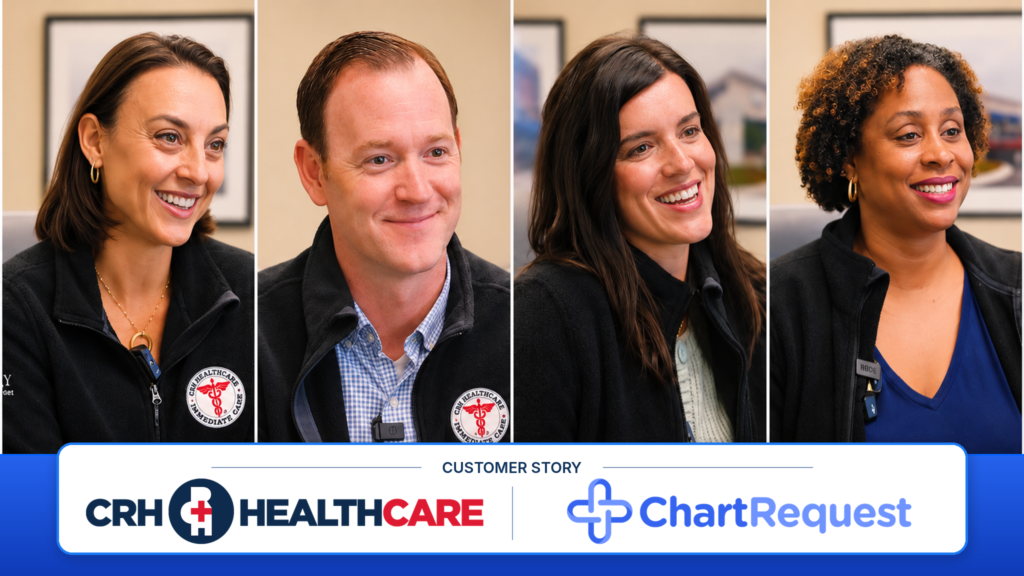
That model now runs across CRH’s locations, in a partnership of more than eight years. CRH’s operations, compliance, and executive leaders explain how it works, how leadership keeps visibility, and why it matters each time the network adds a clinic.
CRH Healthcare x ChartRequest
Request a Multi-Location Workflow Demo
A ChartRequest specialist will follow up to arrange a 20-minute working session.
Why Does Records Release Get Harder as a Network Grows?
Most practices start the same way: employees at each clinic handle records requests as part of their daily work. With a few locations, that works. A small number of people know the process, and leaders can stay close to it.
Every new location changes the math. Across a growing network without a dedicated release of information system, the common pattern looks like this:
- Each clinic develops its own approach. Requests are received, logged, and released differently from site to site.
- Process knowledge sits with individuals. When a staff member changes roles or leaves, that knowledge goes with them, and the next person learns it from scratch.
- Leaders lose a single view. Finding out where a request stands means contacting the location that has it.
- New clinics start from zero. Each acquired or newly opened clinic brings its own habits, and records release becomes one more thing to sort out locally.
CRH started from that same industry-standard model, with clinic employees handling requests internally. As the network grew, CRH’s leadership chose to make records release a defined, dedicated function rather than a task spread across clinic teams. John Richmond, CRH’s Chief Development Officer, explains that decision.
John Richmond, Chief Development Officer at CRH
“Honestly, it’s kind of out of mind for us, which is great. It went from a real pain point for a non-core service to something that we don’t have to think about, freeing up our teammates to focus on delivering the perfect patient experience, which is our mission.”
John Richmond, Chief Development Officer, CRH Healthcare
What Changed for Clinic Staff?
At a busy urgent care clinic, a records request can arrive in the middle of patient registration or while an employee is helping a provider. At CRH’s participating locations, the one-page guide gives staff a single next step: direct the requestor to ChartRequest. Our team handles retrieval and release.
Fulfillment no longer competes with patient care. And because requestors can check status online 24/7, fewer follow-up calls reach the front desk.
Meagan Taylor, RN, CRH’s Vice President of Field Operations, describes what that means for staff during a clinic day.
Meagan Taylor, Vice President of Operations at CRH
“It takes the demand off the clinic. They’re not having to stop what they’re doing. And then we don’t have a lot of patients come back saying, ‘Hey, my physician didn’t get my records,’ or, ‘My insurance company didn’t get what they needed.’”
Meagan Taylor, RN, Vice President of Field Operations, CRH Healthcare
Each group knows its role:
- Clinic staff direct requestors into the established process.
- ChartRequest manages retrieval and release.
- CRH leaders review request activity and meet with ChartRequest monthly to address questions and operational needs.
Because the guide works the same way at every participating location, a new employee learns one step, not a local records process.
How Does CRH Maintain Oversight of Requests?
Outsourcing release of information moves the work, not the responsibility. For patient right of access requests, covered entities remain responsible for meeting access requirements, even when a business associate fulfills them. And for every request, whether it comes from a patient, an attorney, or a payer, HIM and compliance leaders need documentation of what was requested, what was released, and when.
Every location follows the same release workflow and checks, and every request and every access is logged and traceable. Each request has an owner and a status leaders can see, and CRH’s enterprise dashboard brings that activity together across locations without contacting each clinic. Dedicated ChartRequest support and monthly check-ins give leadership a direct point of contact for questions and operational needs.
Pamela Reed, CRH’s Senior Director of Compliance, explains why that evidence trail and support relationship matter to CRH’s compliance function.
Pamela Reed, Senior Director of Compliance at CRH
“ChartRequest is a great partner when it comes to that evidence trail because not only do we have a way to go into our enterprise dashboard to see what the status is, we also have a dedicated team that we can reach out to and ask questions.”
Pamela Reed, Senior Director of Compliance, CRH Healthcare
What Happens When CRH Adds Another Clinic?
An acquired clinic can arrive with a different EMR, its own routines, and staff used to handling requests locally. CRH doesn’t have to redesign records release for each one. The model is already defined: requestors go to ChartRequest, ChartRequest owns fulfillment, and leadership reviews activity in the same dashboard.
Onboarding a new location focuses on setting up access and introducing staff to the handoff. ChartRequest works with all EMR systems, so a different system at an acquired clinic is a setup step, not a barrier. CRH builds on an established medical records release model for multi-clinic groups instead of starting over.
Andrea Malik Roe, CRH’s President and Co-Founder, discusses the partnership’s value as the network expands.
Andrea Malik Roe, President and Co-Founder at CRH
“Today, it’s a consistent, repeatable process that just happens in the background. And we pressure tested this with them across a number of years and a number of EMR systems, and it’s worked every time.”
Andrea Malik Roe, President and Co-Founder, CRH Healthcare
What Do the Results Show Across CRH’s Locations?
The clearest result is what doesn’t happen anymore. Clinic teams don’t stop patient care to fulfill records requests, and CRH doesn’t hear many complaints from patients whose physician or insurance company didn’t get their records. Records release runs as one process across CRH’s locations, and each new clinic joins it instead of building its own.
Since 2018, ChartRequest has processed more than 166,000 records requests that CRH’s clinic staff didn’t have to, with a 2.3-day average turnaround on individual requests, measured from submission until records are prepared.
CRH made this change when it had about 33 clinics. It has kept the same model as it has grown to more than 100 centers.
Andrea Malik Roe sums up why the partnership has lasted.
“I absolutely would recommend ChartRequest… because they take the time to think about your process, what you need as an organization. They adapt their processes to meet your needs and then they execute it efficiently for the duration of your relationship.”
Andrea Malik Roe, President and Co-Founder, CRH Healthcare
See How Your Network Compares to CRH’s Model
In a 20-minute working session, we’ll walk through how requests move across your locations today and compare it to the model CRH runs: who receives requests, who fulfills them, what leadership can see, and how new sites come on board. No patient information is needed.
You’ll leave knowing where dedicated fulfillment would take work off your clinics and what onboarding would involve for your systems. When ChartRequest experts handle your requests, our contracts include a five-day average turnaround guarantee.
Compare Your Locations to CRH’s Model
Submit a demo request, and a ChartRequest specialist will contact you to arrange the session.
Frequently Asked Questions
Is CRH’s Approach Relevant to a Smaller Network?
Yes. CRH made the change when it had about 33 clinics, and the same structure (one handoff, dedicated fulfillment, and leadership visibility) works at any size, scaled to your request volume and the work you want to keep in-house. Setting it up before further growth is often simpler than consolidating different processes later.
Would We Need to Change Our EMRs?
No. ChartRequest works with all EMR systems on the market, so locations on different EMRs can share one fulfillment process. Onboarding each location covers access setup and staff guidance.
Does Outsourcing Release of Information Change Our HIPAA Responsibilities?
No. For patient right of access requests, covered entities remain responsible for meeting access requirements when a business associate fulfills them. Your business associate agreement defines what the release of information partner handles, and a documented record of each request gives you what you need if a release is ever questioned.
How Can Leadership Monitor Activity Across Locations?
CRH uses an enterprise dashboard, dedicated ChartRequest support, and monthly check-ins to review activity and address questions. We’ll match reporting and support to your organization’s needs.
Does ChartRequest Guarantee Turnaround Times?
Yes. When ChartRequest experts handle your requests, our contracts include a five-day average turnaround guarantee.
