


Medical records management best practices for law firms set the leverage, settlement posture, and trial readiness when medical records drive a matter. When requesting, tracking, and reviewing records slows down, strategy slips, and clients lose confidence.
In this article, we’ll cover medical records management best practices to help your law firm standardize intake, tracking, and storage.
ChartRequest simplifies medical records retrieval and management with fast request submission, real-time status updates, and a centralized, searchable dashboard.
Explore how your law firm can automate records retrieval.
Why Your Firm Needs Records Management Best Practices
Use a disciplined records workflow so ownership stays clear and deadlines hold. Consistently following medical records management best practices helps teams scale without chaos.
Watch for early warning signs, including:
- Reopened requests caused by missing identifiers or date ranges
- A 30-plus-day aging bucket that does not shrink
- Missing send or delivery receipts that weaken the chain of custody
- First-pass QC failures creeping above your threshold
- Items sitting in the exception queue longer than 24 hours
Correcting these issues early tightens turnaround and shows clients steady progress. Applied daily, records management best practices support consistent outcomes.
The End-to-End Workflow
Inconsistent workflows create delays, rework, and confusion about who owns the next step. When files are stored in different locations and handoffs vary by person, small gaps in intake or tracking quickly snowball into missed deadlines.
Document your records management best practices so training stays simple. Use the same steps every time so ownership stays clear and training is simpler.
- Intake and preparation
- Submission to the provider’s accepted channel
- Tracking and follow-ups on cadence
- Receipt and quality control
- Attorney review and notes
- Secure delivery to counterparties or experts
This path turns a fragile process into a routine that holds when volume rises. The rest of this guide maps those habits to the steps above. Modern records management best practices align with HIPAA and evidence rules.
Records Management Best Practices Mapped to Each Step
A standard path fixes common problems and makes positive results repeatable. Use the same steps, artifacts, and status cadence on every matter so ownership and metrics stay clear. Make these records management best practices part of your matter playbook.
With ChartRequest, submission, tracking, and receipts are all in one place, keeping the workflow visible.
1) Intake and Preparation
Collect legal name, date of birth, provider list, date range, and a signed authorization. Block submission until required fields are complete so bad requests never leave the office. Clear records management best practices improve first-pass approvals.
Normalize names and identifiers to prevent mismatches. Record alternative spellings, prior names, and medical record numbers when available to increase first-pass approvals across common providers.
2) Submission to the Provider’s Accepted Channel
Submit through the channel the provider accepts and save a timestamped receipt. Include clear instructions and scope so the request is easy to fulfill. Reliable medical records management best practices shorten turnaround and cost.
Maintain a simple provider requirements library that includes portal URLs, required identifiers, delivery preferences, and escalation contacts. With ChartRequest, you submit and track in one place while our team manages provider follow-ups, so your staff rarely needs individual portals.
3) Tracking and Follow-Ups on Cadence
Follow up every three to five business days until delivery and record each touch by date and method. Use a short exception lane for stalled items with a 24-hour action clock.
ChartRequest surfaces real-time status and exceptions so owners can act the same day. This keeps momentum steady and prevents silent stalls. Well-documented records management best practices reduce risk in audits.
4) Receipt and Quality Control
Centralize the delivery, apply OCR, and check for correct patient, dates, and completeness. Confirm imaging study type, facility, and date window against the request, then log any gaps. Client-ready records management best practices show control and momentum.
5) Attorney Review and Notes
Attorneys review a cleared packet and add targeted notes tied to claims and defenses. Link the current packet back to the matter in your document system so annotations stay with the correct version.
Flag any strategic gaps and send a focused follow-up or supplement request. This keeps analysis moving rather than slipping back into triage. These medical records management best practices keep the work visible and defensible.
6) Secure Delivery to Counterparties or Experts
Deliver through secure links with access logging and permissions that expire. Grant only what is needed for the task and revoke access when work concludes to preserve the chain of custody.
Set expectations early, such as PDFs for documents and DICOM for imaging. Where available, request provider certifications so records qualify as admissible business records without a live custodian.
Each stage has a few habits that keep work moving and evidence defensible. Applied daily, records management best practices support consistent outcomes.
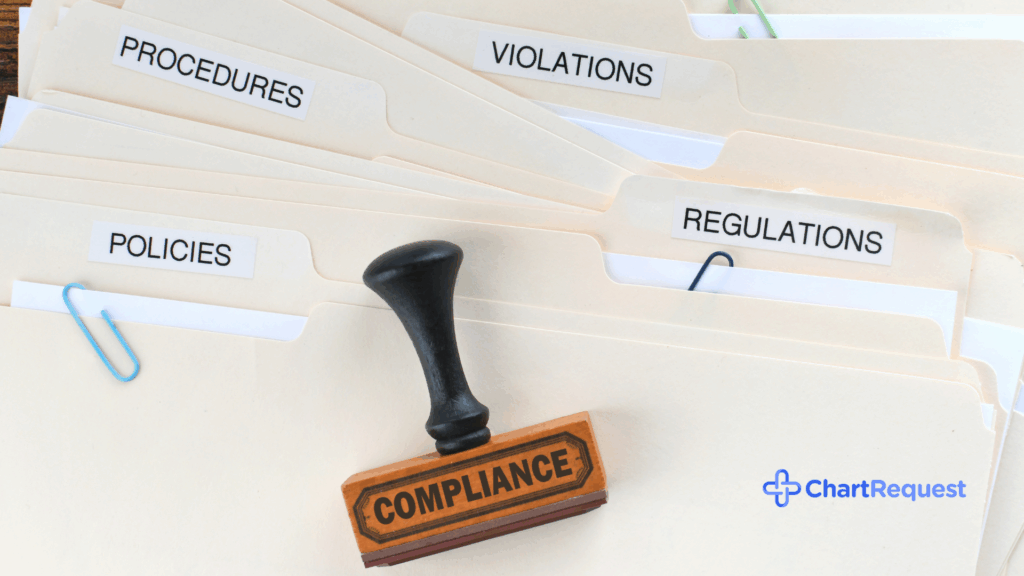
Compliance and Regulatory Medical Record Management Best Practices
Good habits matter more when PHI is involved. These safeguards make the workflow defensible and keep your evidence clean. Document your records management best practices so training for compliance stays simple.
HIPAA litigation paths.
PHI can be disclosed for litigation by three primary bases: a court or administrative order; a subpoena, discovery request, or other lawful process with “satisfactory assurances” under 45 C.F.R. 164.512(e); or a HIPAA-compliant authorization. Modern records management best practices align with HIPAA and evidence rules.
For a court order, disclose only what the order expressly authorizes; for an authorization, follow the scope the client signed; for subpoenas without an order, obtain or make the “satisfactory assurances” required by the Rule (notice to the individual or a qualified protective order).
“Satisfactory assurances” means the requestor shows that the individual was properly notified and had a chance to object, or that a qualified protective order has been requested or entered. A “qualified protective order” must bar use of PHI outside the case and require return or destruction of PHI at the end of the litigation. Keep that documentation with the packet.
Apply the minimum necessary rule unless the disclosure is “required by law” (including a court order) or made pursuant to a HIPAA authorization; in those two paths, minimum necessary does not apply, but scope is still limited by the order or the authorization. Note in your matter file which basis you used so deadlines, objections, and scope track the correct rule.
If your firm is acting as a business associate, ensure the BAA permits disclosures for legal process and follow the same conditions; business associates stand in the covered entity’s shoes for these purposes.
Right of Access and Third-Party Requests
Under HIPAA’s Right of Access, a covered entity must act on a patient’s request within 30 calendar days, with one additional 30-day extension allowed if the patient is notified in writing with the reason for the delay and a new completion date. This same timeline applies when the patient directs the provider to send a copy to a third party, so long as the written request is signed and identifies the recipient and destination.
State law can be stricter. For example, California requires copies to be transmitted within 15 days of receipt of a request; where state timelines are shorter, follow the stricter standard.
By contrast, subpoenas, court orders, and other legal processes run on the dates set by the issuing authority rather than a HIPAA clock. HIPAA requires “satisfactory assurances” for disclosures in litigation (e.g., notice to the individual or a qualified protective order). In federal cases, Rule 45 gives nonparties 14 days to object or the time set for compliance, whichever is earlier.
Authorization requirements and pitfalls
A valid HIPAA authorization must be in plain language and include the core elements and statements the rule requires. At a minimum, it should describe the information, name who may disclose it, identify the recipient, state the purpose, include an expiration date or event, and bear the signer’s printed name, signature, and date. It should also address revocation, the possibility of redisclosure, and whether any services are conditioned on signing.
Most stalls come from preventable defects. Names that do not match IDs, missing or too-narrow date ranges, expired or altered forms, and unclear facility details trigger rejections. Following medical records management best practices helps minimize request rejection.
Certain content needs extra care: psychotherapy notes require a separate, specific authorization, 42 CFR Part 2 records need consent language with a redisclosure prohibition, and a minor’s or incapacitated adult’s records require confirmation of the personal representative’s legal authority. For patient-directed third-party copies, the request must be signed and identify both the recipient and the destination.
Quick check before sending
- Information is described clearly, with who discloses, who receives, and the purpose noted
- Expiration date or event present, plus signer’s printed name, signature, and date
- Correct patient identifiers and complete dates of service
- Facility and campus details are accurate and legible
- Special categories handled correctly (psychotherapy notes; 42 CFR Part 2 consent with redisclosure warning)
- Representative authority is verified when someone signs for the patient
Security Rule Safeguards for Handling Medical Records
HIPAA’s Security Rule groups safeguards into three categories: administrative, physical, and technical. Law firms meet the rule by documenting how each category works in daily practice and by showing evidence that the controls operate. These records management best practices keep the work visible and defensible.
Administrative safeguards
The Administrative Safeguards are the policies and decisions that govern access and behavior. Start with a simple risk analysis, then define who can see what, how new users are onboarded, and how to remove access when matters close. Train staff on secure sharing and phishing basics, and keep a short incident plan that names who escalates and how you document decisions.
Medical records management best practices that align with the administrative safeguards include:
- Access governance with least-privilege roles and quarterly access reviews
- Written procedures for onboarding, off-boarding, and matter closeout
- Short, recurring security training with sign-offs kept in the file
- Matter-based retention schedules and documented litigation holds
Physical safeguards
The physical safeguards protect places and devices. Limit office access, secure workstations, and lock file rooms that may store legacy media. For remote work, require screen locks, full-disk encryption on laptops, and a simple process for reporting lost or stolen devices.
Medical records management best practices that align with the physical safeguards include:
- Facility access controls and visitor procedures
- Workstation security, privacy screens where appropriate, and clean-desk habits
- Device and media controls for storage, transport, and secure disposal
Technical safeguards
The Technical Safeguards protect data in systems. Use unique logins with single sign-on and multi-factor authentication, keep sessions short, and log access and downloads. Encrypt data in storage and in transit, prefer expiring secure links over attachments, and avoid PHI in email subject lines. Preserve immutable originals, keep versioned working copies, and test encrypted backups each quarter so recovery is proven, not assumed.
Medical records management best practices that align with the technical safeguards include:
- Role-based access, audit logs retained for a defined period, and monthly spot checks
- Encryption for files at rest and in transit, including portable media, if used
- Proven backup and restore process with documented recovery targets
Breach Notification Requirements
If your firm experiences a breach of medical records while acting as a business associate, HIPAA requires notice to the covered entity without unreasonable delay and no later than 60 days from discovery, including information to help the covered entity notify affected individuals. Document your medical records management best practices to keep training simple.
Covered entities must then notify individuals within the same outside limit and, when a breach involves 500+ residents of a state or jurisdiction, notify HHS and prominent media within 60 days; for breaches affecting fewer than 500, report to HHS within 60 days after the end of the calendar year in which the breach was discovered.
Most states also have data-breach statutes that may impose shorter clocks and additional regulator notices; follow the stricter rule and any Attorney General reporting thresholds that apply. California, for example, requires health facilities to notify patients within 15 business days of detecting a medical information breach.
Separately from HIPAA, lawyers have an ethical duty to keep clients reasonably informed; ABA guidance explains that a material cybersecurity incident affecting client information generally triggers prompt client notice and a description of remedial steps. Your incident plan should reflect both legal timelines and these professional duties. Make these medical records management best practices part of your playbook.

Measure and Improve Medical Records Retrieval
To know the program is working, measure a few numbers that explain momentum. Use a small scorecard and share it weekly so owners can act. Keeping medical records management best practices and metrics transparent improves the process across your law firm.
Turnaround time. Track days from submission to receipt by the provider and matter type. Long tails usually signal missing identifiers or weak follow-ups.
Aging buckets. Watch the distribution across 0 to 7, 8 to 14, 15 to 30, and 30-plus days. The goal is to shrink the last bucket every week. Visible aging creates focus without blame.
Rework and missing items. Count reopened requests and QC misses by cause. Each cause should have one fix and one owner.
Cost per request. Multiply average hours by a blended rate, then add provider fees and postage. You do not need a complex calculator to see trend lines.
Other Operational Priorities: Roles, SLAs, Client Updates, and Surge Plan
Roles. Attorneys set the scope, review cleared packets, and decide which gaps matter for strategy. Paralegals own intake, submission, tracking, QC, and secure sharing. Operations removes blockers, reviews KPIs, and manages escalation.
SLAs: Set service levels you can meet. Use same-day intake, submission within one business day, follow-ups every three to five days, QC within one day of receipt, and attorney review within two days of QC pass. Post the SLAs where the team will see them.
Client updates: Tie updates to milestones. Notify on submission, first provider response, receipt, and attorney review complete. Share one status line and one next step to show progress without long emails.
Surge plan. Expect peak weeks and plan for them. Keep a preapproved escalation path and message templates so staff stay consistent.
FAQ: Medical Records Management Best Practices
What if a provider refuses electronic signatures?
Submit with the accepted method for that provider and save a receipt. Electronic signatures are legally valid under ESIGN and UETA, but if a provider’s policy requires wet ink, comply and keep the receipt trail. ChartRequest will coordinate the required steps and record each touch so you still have a clean trail.
How often should we audit access?
Run a quarterly access review and correct anything that drifted. Document the date of review and the changes you made.
Where should experts access files?
Use time-limited secure links with access logging. Grant only what the expert needs and revoke access when the purpose is complete.
What if the same record arrives twice?
Store the newer set as a versioned copy and note the difference. Keep the older original read-only so the trail is clear.
How do we handle mixed imaging formats?
Keep all originals together, then create a PDF derivative for fast review. Label by modality and study date so attorneys can scan the folder and pick the correct file.

CaseBinder Helps Law Firms Follow Medical Records Management Best Practices
To make records management best practices easier to run every day, we built CaseBinder around three goals: save time, meet deadlines, and automate follow-up.
With a network of 170k+ providers and a 4.9-star Google reviews rating, CaseBinder makes medical record retrieval simple for attorneys, paralegals, and legal support teams. Benefits include:
- Automated retrieval. A dedicated coordinator handles follow-up and escalations so requests keep moving.
- Easy submission. Guided request workflow, client eAuthorization, fully digital—no calls or fax.
- Real-time visibility. 24/7 status, built-in provider chat, dashboards, and reports.
- Lower costs. No monthly subscription; reduced per-request fees and overhead savings.
- Verified deliveries. Expert verification/redaction with instant, centralized downloads.
- Security & compliance. SOC 2 and ISO 27001 standards, HIPAA-compliant processes, and strong encryption.
Schedule a consultation to map your top providers and see CaseBinder will help your law firm follow medical records management best practices.