



Attorneys win cases by moving fast and staying organized, especially when handling medical records requests. Medical records retrieval provides attorneys with the evidence needed to build strong cases for patients experiencing personal injury, medical malpractice, and other serious issues. When records arrive late or incomplete, your case slows down.
The good news is that attorney requests for medical records can be faster, cleaner, and easier with a repeatable process and the right tools.
This guide gives you a practical plan. It shows the best path for each matter, explains how to avoid common stalls, and lays out a simple seven-step workflow that keeps requests moving. You’ll also see how ChartRequest supports each step so your team spends more time on strategy and less on chasing paper.
Attorney requests for medical records should not be a guessing game. With clear steps and smart follow-through, you can cut turnaround time, reduce rework, and protect client privacy at every stage.
What You Will Learn
- The fastest paths for attorney requests for medical records
- How to choose between a HIPAA authorization, a subpoena, or a court order
- The five bottlenecks that stall requests and how to fix them
- A seven-step workflow you can copy today
- Benchmarks that show what “good” looks like
- How ChartRequest maps to each step for speed and control
Why Speed Matters When Attorneys Request Medical Records
When records arrive early, you gain leverage. Fast access helps you confirm injuries and causation, line up experts, and plan discovery without rushing. Clean files also reduce last-minute surprises that slow negotiations or force schedule changes.
Delays drain staff time and frustrate clients. A steady process for attorney requests for medical records keeps matters moving, protects options before deadlines, and gives your team space to focus on strategy instead of chasing paper.
Fast records also reduce rework inside your firm. When teams use one clear process for attorney requests for medical records, there are fewer corrections, fewer duplicate asks, and fewer last-minute scrambles before hearings and depositions. You spend more time on strategy because intake is right the first time and delivery arrives in the format your experts and paralegals can review quickly.
Choose the Fastest Path for Each Case
The quickest route is the one that matches your facts and your custodian. Before you choose, confirm consent, list facilities and dates, and decide on the delivery format you need for review. This simple pre-work keeps attorney requests for medical records from bouncing in intake and helps custodians act without follow-up questions.
There is more than one way to request health records. Pick the path that fits your facts, your timeline, and the custodian’s rules. This section helps you choose quickly for attorney requests for medical records.
HIPAA Authorization
Use a signed authorization when your client agrees and the custodian accepts it. Include full identifiers, a clear description of the records, the recipient, the purpose, and an expiration with a dated signature. Pre-filling names, date ranges, and facilities helps attorney requests for medical records pass intake on the first try.
Subpoena
Choose a subpoena when consent is not available or records are in the hands of another party. Follow local rules for notice and service, and keep the scope narrow to avoid objections. Clear delivery instructions shorten the path from search to release.
Court Order
Use a court order when records are sensitive or contested. A signed order that names the scope, protections, and delivery format helps the custodian move quickly. This route is slower to start, but can prevent repeated delays later in the case.
Discovery Request
During active litigation, a targeted discovery request ties release to the case schedule. List providers, facilities, and exact dates to limit pushback. Specific asks speed search and reduce the time spent on formatting or redactions.
Administrative Requests
For workers’ compensation and disability, follow the program’s rules and forms exactly. Note any fee policies and request electronic delivery up front. Program-clean packets make attorney requests for medical records easier for custodians to approve.

Common Bottlenecks And How To Avoid Them
Most delays trace back to a small set of problems. Fix these, and your attorney requests for medical records will move faster.
Authorization and Identifiers. Many delays start with small errors like a misspelled name or an incomplete field. Use a standard HIPAA authorization with every required element, and double-check name, date of birth, address, and date ranges before you submit.
Scope Creep. Requests that are too broad take longer to search and prepare. Ask only for what you need now, then stage follow-on requests by phase so attorney requests for medical records move without heavy review cycles.
Custodian Responsiveness. Backlogs and unclear channels slow status updates. Submit through a secure portal, add a short cover note with your due date, and use polite tracked nudges instead of phone loops so progress is documented.
Format and Access. Paper mail and CDs add handling time. Request electronic delivery in readable PDFs for notes and standard image formats for radiology, and confirm any encryption steps to prevent access issues.
Fees and Payment. Confusion about fees leads to waits. Ask for an estimate in your cover note and provide an accepted electronic payment method. Clear payment plans keep attorney requests for medical records from stalling at the finish line.
Some records require extra steps.
Psychotherapy notes are not released with a standard authorization. Substance-use disorder records often require consent that meets stricter standards. HIV/STD, reproductive health, and genetic testing data may have special state rules.
For minors, consent can vary based on service type. For deceased or incapacitated clients, include documentation that identifies the personal representative. When in doubt, ask the custodian which form they require for the fastest lawful release.
The 7-Step Workflow To Cut Turnaround Time
Use this simple checklist for every matter. It is the core of faster attorney requests for medical records.
Step 1: Confirm Path And Scope. Decide whether you will use an authorization, subpoena, court order, discovery, or an administrative route. List the facilities, providers, service dates, and record types you need, and choose your preferred delivery format.
Step 2: Prepare A Complete Packet. Include the signed authorization or legal instrument with all required elements. When allowed, attach a copy of the client ID and a short cover note that states your contact info, due date, and delivery preference.
Step 3: Pre-Validate Identifiers. Cross-check the spelling of names, the date of birth, address, and any internal IDs. Make sure the requested date range matches the incident or treatment window so intake can approve your request on the first pass.
Step 4: Submit Electronically. Use a secure portal rather than fax or mail. Capture the timestamped receipt and save it to the matter so you can track attorney requests for medical records without digging through emails.
Step 5: Track Due Dates And Nudge. Set reminders against statute or program windows. Send a brief status check before the due date and escalate with clear facts if the request is at risk.
Step 6: Receive And Quality-Check. Compare what you received to your scope list. If items are missing, send a short correction request that notes the exact gaps by facility and date range.
Step 7: Store, Log, And Share. Save the files in a secure system with access controls and audit logs. Link the records to your matter workspace so your team can review without delays.

What “Good” Looks Like: Practical Benchmarks
Every custodian is different. Record types vary. Even so, you can measure progress. Use these practical signs to judge your attorney requests for medical records process.
- First-time acceptance of your packet
- Electronic delivery in readable formats
- Fewer resubmits and corrections
- Clear due date tracking and on-time receipt
- Shorter internal review time due to clean files
Start with your current baseline. Improve one step at a time. Document your gains.
Best Practices For Attorney Medical Record Requests
These small habits add up. They protect privacy and cut wasted effort across attorney requests for medical records.
- Be clear and specific: List facilities, date ranges, and types of records
- Request only what you need: Reduce search time and fees
- Use secure channels: Protect PHI at rest and in transit
- Standardize your cover note: Contact info, delivery preference, due date
- Keep a custodian rolodex: Save emails, portals, and special instructions
- Log every event: Submission time, receipts, status checks, and delivery
- Train your team: Use one checklist so everyone follows the same steps
Security And Compliance Without The Headache
Privacy is not optional. You need speed and control. The right process keeps both. When you handle attorney requests for medical records, make sure you:
- Use systems with encryption at rest and in transit
- Limit access by role and log every access
- Keep authorizations and court documents with the request
- Store files in a secure workspace with audit trails
- Follow local rules and program guidance
This keeps clients safe and reduces rework from compliance errors.
FAQs For Attorneys
How long do attorney requests for medical records usually take?
Timelines vary by custodian, record type, and jurisdiction. Your fastest path is a complete packet, electronic submission, and steady follow-up.
Do I need a subpoena, or will a HIPAA authorization work?
Use a valid authorization when your client consents and the custodian accepts it. Use a subpoena or court order when consent is not available, scope is contested, or rules require it for attorney requests for medical records.
What must a HIPAA authorization include for attorney requests for medical records?
Identifiers, a description of the information, the recipient, the purpose, an expiration, and a signed and dated form. Add facilities and date ranges to reduce questions.
Can a provider refuse to release records to an attorney?
A provider can deny or limit requests that are incomplete, outside scope, or not compliant with law or policy. Fix the issue and resubmit, or use a different path for attorney requests for medical records.
What formats should I request?
Ask for electronic delivery. PDFs for notes and standard image formats for radiology are common. Confirm encryption and access steps for attorney requests for medical records.
Who pays the fees?
Fees depend on jurisdiction, record type, and program. Ask for an estimate up front and provide your payment method in the cover note.
Internal Team Tips
Small team habits keep attorney requests for medical records on track.
The firms that scale attorney requests for medical records best treat the process like a product: clear owners, tight checklists, and routine audits.
- Hold a weekly 15-minute review of pending requests
- Triage overdue items with a simple escalation plan
- Track first-time acceptance rate as a quality metric
- Save successful packets as reusable templates
- Keep one source of truth for due dates and receipts
As your team applies these habits, document what works and standardize it. When you improve attorney requests for medical records, momentum grows across cases. Small, consistent gains turn into faster review, fewer corrections, and happier clients.

How ChartRequest Helps Attorneys Request Medical Records
Fast records help you build strong cases. A clear path, a complete packet, and steady follow-through make attorney requests for medical records faster and safer.
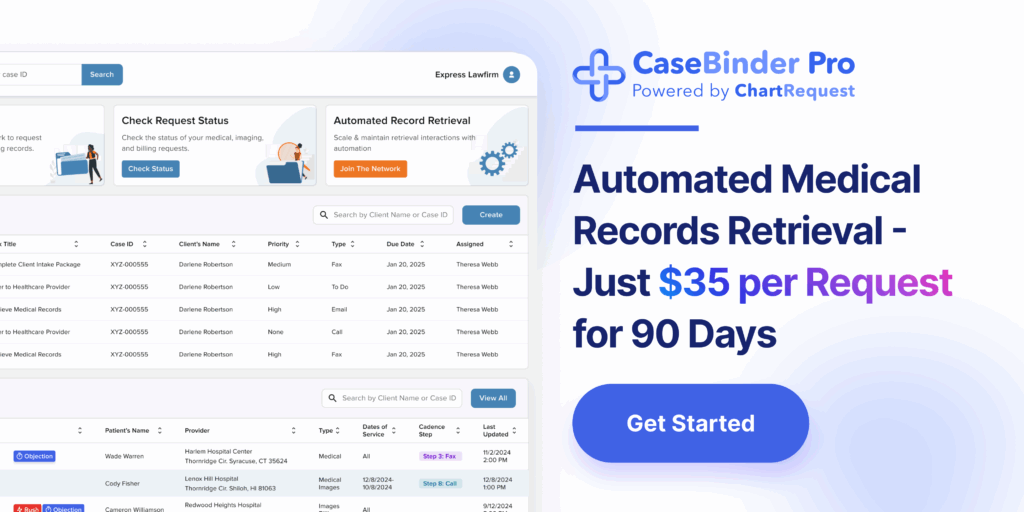
CaseBinder by ChartRequest was built to reduce friction in attorney requests for medical records. It gives you the tools and service to move each request from submit to delivery with less effort.
Secure Electronic Submission. Send requests through a secure portal with your delivery preference and notes, and receive a receipt you can file with the matter. Clean intake reduces back-and-forth and speeds approval for attorney requests for medical records.
Real-Time Tracking And Auto Nudges. See status and due dates in one place, and send polite reminders without phone loops. Documented touchpoints keep progress visible and prevent last-minute scrambles.
White-Glove Retrieval. Offload follow-ups to a trained team that handles confirmations and escalations. Your staff can stay focused on legal work while requests continue to move.
Clean Electronic Delivery. Receive records in standard formats with a clear audit trail. Electronic files shorten review time and make sharing inside the firm secure and straightforward.
Interested in automating medical records retrieval? Book a short CaseBinder demo to learn how we can help.
This guide provides general information. It is not legal advice. Always follow local rules and program guidance for attorney requests for medical records and related disclosures.